Showing posts with label danyelle. Show all posts

Friday, December 23, 2022

From Our Bookshelves 2022

As we wrap up 2022, we enthusiastically recommend sixteen of our favorite books from this year.  We love discovering books that make us want to read and re-read them—books that we can’t wait to share with the children in our lives.  We hope you enjoy them, too.

Picture Books:

  • Mina by Matthew Forsythe
  • Rodney Was a Tortoise by Nan Forler, illustrated by Yong Ling Kang
  • Somewhere in the Bayou by Jarrett Pumphrey, illustrated by Jerome Pumphrey
  • Knight Owl by Christopher Denise
  • The Depth of the Lake and the Height of the Sky by Jihyun Kim
  • Farmhouse by Sophie Blackall
  • A Bear, A Bee, and a Honey Tree by Daniel Bernstrom, illustrated by Brandon James Scott

Fiction:

  • Healer & Witch by Nancy Werlin
  • The Bluest Sky by Christina Diaz Gonzalez
  • Black Bird, Blue Road by Sofiya Pasternack
  • Swim Team by Johnnie Christmas

Folktales:

  • The Three Billy Goats Gruff by Mac Barnett, illustrated by Jon Klassen

Nonfiction:

  • Solitary Animals: Introverts of the Wild by Joshua David Stein, illustrated by Dominique Ramsey
  • A Seed Grows by Antoinette Portis
  • Unbreakable: The Spies Who Cracked the Nazis’ Secret Code by Rebecca E. F. Barone
Poetry:
  • Ain't Burned All the Bright by Jason Reynolds, illustrated by Jason Griffin

If you are looking for more book recommendations, browse these best-of-the year lists and award winners.

Bookpage Best Middle Grade and Chapter Books of 2022  

Bookpage Best Picture Books of 2022  

Horn Book Fanfare 2022  

Kirkus Best Picture Books of 2022  

Kirkus Best Middle-Grade Books of 2022  

NCTE Charlotte Huck Award for Outstanding Fiction for Children 2023

NCTE Orbis Pictus Award for Outstanding Nonfiction for Children 2023  

The New York Times/New York Public Library Best Illustrated Children's Books of 2022  

Publishers Weekly Best Children's and YA Books 2022  

School Library Journal Best Books of 2022   

Tuesday, December 28, 2021

From Our Bookshelves 2021


With 2022 just a few days away, we would like to share fifteen of our favorite books from 2021.  These are the books that we read, re-read, and recommended.  

Picture Books:
  • Unspeakable: The Tulsa Race Massacre by Carole Weatherford, illustrated by Floyd Cooper
  • Mel Fell by Corey R. Tabor
  • Watercress by Andrea Wang, illustrated by Jason Chin
  • The Little Wooden Robot and the Log Princess by Tom Gauld
  • Survivor Tree by Marcie Colleen, illustrated by Aaron Becker
  • It Fell from the Sky by Terry and Eric Fan
  • Off-Limits by Helen Yoon
Fiction:
  • Fox + Chick: The Sleepover by Sergio Ruzzier
  • Dulcinea in the Forbidden Forest by Ole Konnecke
  • Just Like That by Gary D. Schmidt
  • Born Behind Bars by Padma Venkatraman
  • The Beatryce Prophecy by Kate DiCamillo, illustrated by Sophie Blackall
Folktales:
  • Across the Rainbow Bridge: Stories of Norse Gods and Humans by Kevin Crossley-Holland, illustrated by Jeffrey Alan Love
Nonfiction:
  • Fallout: Spies, Superbombs, and the Ultimate Cold War Showdown by Steve Sheinkin
  • The Genius Under the Table : Growing Up Behind the Iron Curtain written and illustrated by Eugen Yelchin

Wednesday, February 14, 2018

Cybils Awards 2017

The Children's and Young Adult Bloggers' Literary Award Winners were announced today.  Head on over to the Cybils site to check out all the winners.  While you are there, be sure to look up the winners for the Junior High Nonfiction and Senior High Nonfiction categories.  I was lucky enough to be able to work on those committees and enthusiastically recommend the winners.  If you haven't read them, add them to your reading list.

Children's and Young Adult Bloggers' Literary Awards

Wednesday, December 13, 2017

From Our Bookshelves 2017


We're excited to recommend our favorite twenty books of 2017.  These are the books that we have read and re-read, thought about, talked about, and shared.   We hope you'll love them, too.

Picture Books:
  • The Wolf, the Duck, and the Mouse by Mac Barnett, illustrated by Jon Klassen
  • Walk with Me by Jairo Buitrago, illustrated by Rafael Yockteng
  • Wolf in the Snow by Matthew Cordell
  • The Rooster Who Would Not Be Quiet! by Carmen Agra Deedy, illustrated by Eugene Yelchin
  • When’s My Birthday? by Julie Fogliano, illustrated by Christian Robinson
  • Egg by Kevin Henkes
  • A Greyhound, a Groundhog by Emily Jenkins, illustrated by Chris Appelhans
  • The Little Red Cat Who Ran Away and Learned His ABC’s (the Hard Way) by Patrick McDonnell
  • After the Fall: How Humpty Dumpty Got Back Up Again by Dan Santat
  • Town Is by the Sea by Joanne Schwartz, illustrated by Sydney Smith

 Fiction:
  • Wishtree by Katherine Applegate
  • Bronze and Sunflower by Cao Wenxuan, translated by Helen Wang
  • Princess Cora and the Crocodile by Laura Amy Schlitz, illustrated by Brian Floca
  • Beyond the Bright Sea by Lauren Wolk

 Nonfiction:
  • Dazzle: World War I and the Art of Confusion by Chris Barton, illustrated by Victo Ngai
  • Grand Canyon by Jason Chin
  • Vincent and Theo: The Van Gogh Brothers by Deborah Heiligman
  • Undefeated: Jim Thorpe and the Carlisle Indian School Football Team by Steve Sheinken
  • The Secret Project by Jonah Winter, illustrated by Jeanette Winter

 Poetry:
  • I’m Just No Good at Rhyming: And Other Nonsense for Mischievous Kids and Immature Grown-Ups by Chris Harris, illustrated by Lane Smith

And if you're looking for more end-of-the-year lists and award winners, the links below are a great place to start.

Wednesday, November 22, 2017

It's Beginning to Look A Lot Like Christmas

'Tis the season . . . to pull out your favorite holiday books, and maybe add a few more to your pile. We wanted to spotlight some new books that were released this year.  Although very different in style and story, they all highlight a very important aspect of any holiday -- tradition.  Whether picking a perfect Christmas tree, eating special foods, giving gifts or singing songs, let your customs and quirks shine this holiday season, and don't forget to share a good book!

danyelle shares:

Red & Lulu
by Matt Tavares
published by Candlewick Press

Red and Lulu, a pair of cardinals that live “on the branches of a mighty evergreen”, are happy in what they consider a perfect home, until one day as winter is setting in, Red returns to find that the tree—with Lulu inside it—is being taken away.  Red chirps for Lulu to stay where she is and promises to find her.  His search takes Red to a “strange place” that readers will recognize from the light-infused, bird’s-eye view illustrations of the New York Public Library, the Empire State Building, and the streets of New York City.  It won’t surprise anyone when Red and Lulu are reunited, but readers will almost certainly learn something new from the added information at the end of the story about the birds’ new home—the Rockefeller Center Christmas Tree.  Make sure you take a peek under the dust jacket at the elegant, snowy cover.

review copy received from publisher


The 12 Days of Christmas
by Greg Pizzoli
published by Disney Hyperion Books

When a young elephant’s friend shows up with a partridge in a pear tree, his dad is a little wary and becomes more concerned still when the friend returns on the second day with a pair of turtle doves.  The gifts continue to come, following the lines of the traditional song (three French hens, four calling birds, five golden rings), but with Pizzoli’s comic twists added into the pictures (a swan arrives with an alligator float, the maids a-milking are mice carrying cartons and glasses of milk).  With each successive gift, Dad becomes more distressed, and the children and the gift-characters are too caught up in their own boisterous celebration to notice, until finally he breaks down in tears.  The cartoon eyes are simple, yet unmistakably expressive, whether Dad is glaring out the window, looking with apprehension at the gifts, or warming up to the affection of new friends. Eventually, Dad softens, and the final page with a stocking hung for each bird, mouse, pig, cat, frog, bunny, and elephant lets readers know that all the characters will be celebrating Christmas together.  Great for reading aloud and singing along.


tara shares:

Pick A Pine Tree
by Patricia Toht
illustrated by Jarvis
published by Candlewick Press

The metallic lettering and bow adorning the dust jacket wrap up a cheerfully illustrated nod to the distinct and magical experience of choosing the perfect pine tree to decorate for Christmas.

"Pick a pine tree
from the lot --

slim and tall
or short and squat."

Rhythmic text guides you through visiting the tree lot, finding just the right tree, bringing it home and decorating with friends and family.  Warm colors and descriptive verse highlight the smells, lights, trimmings and family that are required to transform a humble pine into the perfect Christmas tree.  I love illustrations with reappearing characters (the birds from the beginning make an appearance at the end of the book) and my children loved watching the happy pets join in the family festivities.

review copy received from publisher


A Christmas for Bear
by Bonny Becker
illustrated by Lady MacDonald Denton
published by Candlewick Press

Bear and Mouse -- unlikely friends that fit together so well.  In this holiday installment of the Bear and Mouse franchise, we see Bear hosting a holiday party for his friend and because he has never had a real Christmas he must rely on what he has read, and "Clearly, the most important thing was pickles."

Though not familiar with "Christmas pickles," it was easy to be drawn into the back and forth exchanges between curmudgeonly Bear and curious Mouse.  While Mouse sneaks away to search for presents, Bear repeatedly brings him back.

                          "Unnecessary hogwash!"  Bear scolded.  "We have pickles, remember."
                          "Oh," said Mouse.
                          And Mouse trudged behind Bear back to the living room.

Each time, Mouse dutifully returns to his friend's party to eat pickles "from France" and to listen to Bear read a "long and difficult poem" even though all he wants is a Christmas present.  The watercolor, ink and gouache illustrations delightfully capture the emotions and sweet relationship between the two while transforming a grumpy Bear and disappointed Mouse with a fitting holiday resolution.

review copy received from publisher

Friday, December 18, 2015

From Our Bookshelves 2015

'Tis the season for many things . . . including end-of-the-year lists.  You'll want to check these lists twice to make sure you didn't miss any of the year's best.

Horn Book Fanfare

Kirkus Best Middle-Grade Books

School Library Journal's Best of 2015

Publisher's Weekly's Best Children's Books

The New York Times Notable Children's Books
The New York Times Best Illustrated Children's Books

National Book Awards


And, finally, here are our favorites of 2015.  These are books that we read, loved, and shared again and again.   We whole-heartily recommend them.

Picture Books:
Fiction:
  • The Nest by Kenneth Oppel, illustrated by Jon Klassen
  • Echo by Pam Munoz Ryan
  • Audacity by Melanie Crowder
  • The Hired Girl by Laura Amy Schlitz
  • Orbiting Jupiter by Gary D. Schmidt
Nonfiction:
Poetry:
  • Over the Hills and Far Away: A Treasury of Nursery Rhymes collected by Elizabeth Hammill, illustrated by more than 70 artists

Friday, October 23, 2015

Spotlight on Nonfiction 2015

Drowned City: Hurricane Katrina & New Orleans by Don Brown

Most teenagers won't remember ten years ago when Hurricane Katrina pounded New Orleans, after they read Don Brown's account in Drowned City, they won't likely forget it.  The account starts with an African breeze that grows to a category three storm over the Atlantic.  By the time Katrina hits just east of New Orleans, it has slipped to a category three storm, but still it breaks levees, floods the city with one million gallons of water per minutes, and leaves 80% of the city under water.

In this graphic novel readers see the dramatic story unfold across the pages.  Illustrations of people standing, slumping, leaning, and trying to escape the water are filled with desperation and humanity.  And it's the impact of the storm on those people that drives the story.  We see 20,000 people packed into the Superdome with no electricity, no sanitation, and insufficient food and water.  We see a man hold a baby above the floodwaters as he tries to escape.  We see a couple race up the stairs of their home just ahead of the water.  They use a knife to scrape a hole in the roof and get out just in time.  We see people stranded on rooftops surrounded by rising floodwaters.  And we see those that don't make it.

Brown brings readers right into the disaster, recounting the many failures: 360 city buses don't show up to evacuate residents; empty trains leave the city; police abandon their post; there is a lack of communication and coordination between government agencies; there is looting and shooting; more than 1400 people die.  He also describes the rescue efforts of individuals and agencies.  Despite stagnant water teeming with garbage, oil, poisonous snakes, and dead bodies, more than 40,000 people are rescued.

This accessible account leads readers into complex ideas and questions.  What could the government have done better?  Where does responsibility to protect people from natural disasters lie?  How far should society go to protect individuals who choose to stay in harm's way?  What role did race and poverty play in the government response to the disaster?

Brown incorporates quotations from survivors and includes meticulous annotations and bibliographic information.

This is a power book.


The Boys Who Challenged Hitler: Knud Pedersen and the Churchill Club by Phillip Hoose

I've always admired the Danish Resistance during World War II, particularly the heroic transport of most of the Danish Jews to Sweden before they could be rounded up by the Nazis.  What I didn't realize until I read this book is that the Resistance had a slow start.  While fearful and overwhelmed adults in Denmark capitulated to German demands, a small group of young boys fought back.  14-year-old Knud Pedersen and his brother Jens, along with a few of their friends, were disgusted with Danish leaders, and admired the way Norway was fighting against the German.  In broad daylight, they fought by twisting traffic signs and spraying walls with blue paint.  Their activities escalated to sabotage, arson, and stealing weapons.  They called themselves the Churchill Club and their actions inspired others to resist and the Danish Resistance grew.

Engrossing from page one, Hoose's account is based on extensive interviews with Knud Pedersen.


Terrible Typhoid Mary: A True Story of the Deadliest Cook in America by Susan Campbell Bartoletti

When George Soper was hired to figure out the source of a typhoid outbreak that infected six members of the Warren household in 1906, his investigation led him to Mary Mallon, a cook who had infected at least 24 people.  Mary turned out to be the first documented healthy typhoid carrier in the United States.

In this highly readable biography, Susan Campbell Bartoletti looks at Mary's plight.  She was not just "a living culture tube" or "a chronic typhoid germ producer" as George Soper called her, but she was also an intelligent, fiery tempered, fiercely private, independent, Irish woman who didn't accept Soper's assertion that she was making people sick.

This book and Gail Jarrow's superb book, Fatal Fever: Tracking Down Typhoid Mary, look at the same subject.  While Jarrow follows Soper's investigation of the medical mystery, Bartoletti's focus is on Mary.  Together these books make an excellent choice for student analysis of the different approaches authors take in texts with the same topic.

Spotlight on Fiction 2015

Circus Mirandus by Cassie Beasley

If the stories that Micah's grandfather told him are true . . . if there really is a place where an elephant named Big Jean can do long division, where a French vulture can tell the future, and where an illusionist can make you fell the frosty winds of Antarctica while you sitting in your chair . . . if Circus Mirandus is an actual circus . . . then "that [means] magic [is] real" . . .(17)  and maybe, just maybe, magic can save Micah's dying grandfather.  When Micah's grandfather, Ephraim Tuttle, visited Circus Mirandus as a boy, the Man Who Bends Light promised him a miracle.  He's been saving that miracle for a time when he really needs it, and that time is now.  Micah is certain that if he can get into the circus and talk to the Man Who Bends Light, the Lightbender will save his grandfather.

In alternating chapters, a family mystery slowly unfolds just as the tension in Micah's story builds, creating suspense that will keep readers turning pages right up to the end.  This story is just the right blend of the fantastic and the sometimes difficult realities of the real world.


The Nest by Kenneth Oppel, illustrated by Jon Klassen

The Nest came out just a couple of weeks ago, and it already has racked up five starred reviews.  It is deliciously creepy, not in a blood-and-gore kind of way, but in a get-inside-your-head kind of way.

Steven has been coping with anxiety and bad dreams for a while and now there is more tension at his house because his newborn brother has a rare congenital problem.  Even though his therapist assures him that "what happens in a dream stays inside the dream," Steven's latest dreams with creatures of light that promise to "make things better" seem all too real.  (110, 23)  And in some ways, he wants them to be real.

The first-person telling puts readers right into Steven's thoughts as he struggles to figure out what is a dream and what is reality.  That ambiguity makes this a psychological thriller that you'll read in one sitting.  (I did.)  Oh, and the villain is the most chilling I've met in a long time.  I bet it'll change the way you feel about wasps.


The Hired Girl by Laura Amy Schlitz

Laura Amy Schlitz describes her new book as a "good old-fashioned story" and that is exactly what it is.

Since her mother's death, 14-year-old Joan does all the woman's work on Steeple Farm, and it's hard work: she takes care of the chickens, cleans out the privy, cooks meals for her father and four brothers, does laundry, and puts food by.  When her father decrees that she can no longer attend school and then burns the few books she owns, Joan decides there is nothing left on Steeple Hill for her, and she goes to Baltimore to become a hired girl.  She has little idea what she is getting into, but she is desperate enough to take a chance on a better life.

In Baltimore she  begins a very different life working for a Jewish family.  While she enjoys the conveniences of electricity, hot and cold running water, a dumbwaiter, and a carpet sweeper, Joan works to learn the Jewish rules of kashrut and appease cranky Malka.  But it is the more universal experiences that change her.  She learns to respect people's differences.  She learns about men who are, thankfully, not all like her father, and gets her first kiss.  She learns about meddling (not a good idea to pass on a love sonnet you found to help a relationship along), heartbreak (things don't go well after that first kiss), and forgiveness.

Written as a series of Joan's diary entries, the story is set in 1911 and the relevant social issues of the time--women's rights, class division, religious prejudice, and labor rights--are addressed.  Historical details and content infuse seamlessly into the story; readers will feel like they've been picked up and placed right in Joan's world.

Spotlight on Picture Books 2015

Float by Daniel Miyares

Miyares is fairly new to picture books (his first illustrated book came out 2010), but boy, does he know what he is doing!  Float is the wordless story of a boy who takes a boat folded from newspaper out to play.  When the rain starts, he floats it in puddles and in the gutter, but the boat gets away from him and ends up destroyed.  Dejected, he trudges home holding his water-soaked paper.  But, with a little comfort and help from home, he is soon off on a new adventure.

The gorgeous illustrations are filled with movement and the exuberance of childhood play.  Ink and watercolor backgrounds in shades of gray with a just a hint of color make the pages look as rain-soaked as the boy's adventure, and his rain jacket in brilliant yellow foreshadows the final scene while keeping readers' attention focused on the boy.

Varied perspective, perfect pacing, and impeccably-placed page turns make this one of my favorite picture books of the year.


Wolfie the Bunny by Ame Dyckman, illustrated by Zacharia O’Hora

If you are looking for a fabulous and funny new read aloud, Wolfie the Bunny is it.

The Bunny family finds a baby on their doorstep.  A wolf baby--an adorable wolf bunny.  Dot, the bunny daughter is understandably concerned.  "He's going to eat us all up!"  "But Mama and Papa [are] too smitten to listen."  Oblivious to any danger, her parents take pictures and dote on their new son, Wolfie, as Dot continues to warn them: "He's going to eat us all up!"

Dot's persistently annoyed expression makes her all the more delightful, and her feisty protestations make for some of the funniest moments in the book.  In a twist at the end of the story, it's spunky Dot who proves herself the hero of the family.

Adults will appreciate the tongue-in-cheek mocking of any parent who has even been "smitten" with a child, and kids will understand--and laugh at--Dot's frustration with her new brother.


Gingerbread for Liberty: How a German Baker Helped Win the American Revolution by Mara Rockcliff, illustrated by Vincent X. Kirsch

We all know Revolutionary War heroes like George Washington, Nathanael Greene, Patrick Henry, and Ethan Allen, but in Gingerbread for Liberty, we meet an unlikely hero--a baker.  Christopher Ludwick was a German baker who owned a gingerbread bakeshop in Philadelphia.  He had a big booming laugh and a kind and generous disposition.  And he was a patriot.  When the Revolutionary War started, the baker (who was too old and fat to be a soldier), built ovens and made bread at his own expense for the soldiers.  Then, when England sent Hessian soldiers to fight the patriots, the baker volunteered to talk to them.  Under cover of night, he rowed out to the Hessian army and convinced many of the soldiers to switch sides.

Bits of humor in the text and art add a touch of lightness to this war story that will draw in young audiences.  Paper cut-out illustrations resemble gingerbread cookies, creating stylized scenes that allow the baker's personality to shine through.  An author's note at the end has additional information that you must read before sharing the book.


Finding Winnie: The True Story of the World's Most Famous Bear by Lindsay Mattick, illustrated by Sophie Blackall

This true story of the original bear named Winnie was written by the great-granddaughter of Harry Colebourn, the man who raised the bear, as a bedtime story for her son, Cole.  Harry was a veterinarian serving as a captain in the Canadian military during World War I when he saw a trapper with a bear cub at a train station.  He purchased the bear for $20 and named her Winnipeg (or Winnie for short) after his hometown.  After Harry convinced his Colonel to let him keep the cub, Winnie became a mascot of sorts for the brigade and traveled with them across the ocean to England.  But when the men had to join the fighting in France, Harry left her at the London Zoo.  It was there that she was visited by Christopher Robin (son of A. A. Milne) who was allowed to play in Winnie's enclosure.  Their friendship inspired  Milne's Winnie the Pooh stories.

Beautiful illustrations by Sophie Blackall include panels, spot art, double-page spreads, and details that encourage readers and listener to linger over every page.  Period photos decorate the final pages in scrapbook style.

Friday, May 29, 2015

May Storytime Briefly 2015

I have conflicting feelings about the month of May.  First, I am counting down the days until school lets out.  I look forward to summer days with no homework, no school projects, and no bell schedule.  Summer is the time when I get to decide what to do with my children, and I love it.  On the other hand, it also the last month of storytime at school, and I know I will miss the students I have come to know this year.

I decided to wrap up the year with fables, folktales, and biographies.

Among all the biographical stories we read this year, there was not a single one about a woman, so we took a week to look at a couple of amazing women.  We read
  • Brave Girl: Clara and the Shirtwaist Makers' Strike of 1909 by Michelle Markel, illustrated by Melissa Sweet and
  • The Tree Lady: The True Story of How One Tree-Loving Woman Changed a City Forever by H. Joseph Hopkins, illustrated by Jill McElmurry.

We talked about Aesop's Fables with the following stories:
  • "The Fox and the Crow" retold with puppets and
  • Mouse & Lion by Rand Burkert, illustrated by Nancy Ekholm Burkert.
We talked about flattery and about morals.  The students did a great job of articulating the lessons that could be learned from Mouse & Lion.


We finished the year with these folktales from Africa:
  • Mrs. Chicken and the Hungry Crocodile by Won-Ldy Paye, illustrated by Margaret H. Lippert and
  • "The Girl who Loved Danger" told using Steve Light's story box.
I cannot recommend Steve Light's story boxes enough.  They making storytelling fun for kids and adults alike.  And I think it was the perfect way to end the year.

Thursday, April 30, 2015

April Storytime Briefly 2015

In my neck of the woods, April was filled with the craziness of bunnies, blossoms, and snow.  This month's storytimes reflect that.

We started the month with books about rabbits.  We read
  • The Black Rabbit by Philippa Leathers;
  • Muncha! Muncha! Muncha! by Candace Fleming, illustrated by G. Brian Karas; and
  • Wolfie the Bunny by Ame Dyckman, illustrated by Zacharia OHora.
Wolfie the Bunny was huge hit.  One boy, in particular, laughed at almost every page turn.  That's a keeper!

We read Native American folktales:
  • Rabbit's Snow Dance by James and Joseph Bruchac, illustrated by Jeff Newman and
  • Coyote: A Trickster Tale from the American Southwest by Gerald McDermott.
We had a spring snowstorm which seemed like the perfect time to share Rabbit's Snow Dance, and the Native American folktales dovetailed nicely with what the students were learning in class.
We talks about ocean animals by reading
  • "About the Teeth of Sharks" by John Ciardi;
  • Humphrey the Lost Whale by Wendy Tokuda, illustrated by Richard Hall; and
  • Trapped! A Whale's Rescue by Robert Burleigh, illustrated by Wendell Minor.
I'm not sure the shark poem entirely fit with the whale theme, but I love sharing this poem during National Poetry Month.  The two books about whale rescue provided an interesting contrast, not just because the rescue methods were different, but because Humphrey trapped himself by swimming up the river, and the whale from Robert Burleigh's book was trapped by human-made nets.

Tuesday, March 31, 2015

March Storytime Briefly 2015

My parents' children--all eight of us--were born in different months, so when I was growing up, we each claimed our birthday month as our own.  And because I still feel a little like March is my month, I decided to share my favorite things.  I introduced the month by sharing
  • My Favorite Things by Oscar Hammerstein, music by Richard Rodgers, illustrated by James Warhola.
Then each week we talked about some of my favorite authors and illustrators, past and present.


My favorite poems to memorize when I was a kid were Shel Silverstein's.  Memorizing fourteen lines of light verse was a whole lot easier than memorizing William Shakespeare.  For storytime, we read/recited the following:

  • "Kidnapped!" by Shel Silverstein, from A Light in the Attic;
  • "Skin Stealer" by Shel Silverstein, from A Light in the Attic;
  • "Crocodile's Toothache" by Shel Silverstein from Where the Sidewalk Ends; and
  • "Sick" by Shel Silverstein, from Where the Sidewalk Ends.
Just as I was wrapping things up and heading out the door, I got a request to read "Boa Constrictor." Unfortunately, we were out of time--I'll have to find a way to incorporate that into an upcoming storytime.


When I was a second grader, my favorite book to take on road trips was an Encyclopedia Brown book.  Any Encyclopedia Brown book.  The episodic chapters make the books easy to set down and pick up again when your family makes frequent stops as mine did.  I introduced the students to Encyclopedia Brown, talked about what encyclopedias are, and read
  • "The Case of the Silver Fruit Bowl" from Encyclopedia Brown Keeps the Peace by Donald J. Sobol.
Before reading the solution at the back of the book, I asked the students if they thought they could solve the case.  They are pretty observant third graders and had some great ideas.


We looked at Erin Stead's beautiful illustrations and discussed woodcuts, linocuts, and the process for making prints.  We read
  • A Sick Day for Amos McGee by Philip C. Stead, illustrated by Erin E. Stead;
  • And Then It's Spring by Julie Fogliano, illustrated by Erin E. Stead; and
  • If You Want to See a Whale by Julie Fogliano, illustrated by Erin E. Stead

Jon Agee's new book, It's Only Stanley, came out just in time to be included in my month of favorite things.  We talked about humor and read
  • It's Only Stanley by Jon Agee;
  • Little Santa by Jon Agee; and
  • Milo's Hat Trick by Jon Agee.
And I'll ask again what I always ask when I talk about Milo's Hat Trick: Why is this fantastic book out of print?  Bring it back.  Please.

Saturday, February 28, 2015

February Storytime Briefly 2015

American Library Association Awards, Chinese New Year, and storytelling -- there was much to talk about in February and great stories to read.

We talked about the Geisel Award and the Caldecott Award.  We read

  • You Are (Not) Small by Anna Kang, illustrated by Christopher Weyant;
  • The Noisy Paint Box: The Colors and Sounds of Kandinsky's Abstract Art by Barb Rosenstock, illustrated by Mary GrandPre; and
  • The Adventures of Beekle: The Unimaginary Friend by Dan Santat.
I pulled out other award-winning books from 2014, and a cheer erupted when I announced that Sam & Dave Dig a Hole (by Mac Barnett and Jon Klassen) had been given a Caldecott Honor.  Yep, they liked that book.


Our school holds a storytelling event in the month of February where students tell stories in their classrooms.  Each teacher then selects a student to represent her classroom at a school-wide assembly.  While the kids were preparing their stories, I decided to tell one of my own, so we celebrated Chinese New Year with following stories:

After hearing "The Fox Borrow's the Tiger's Fierceness," one boy commented on the story's similarity to The Gruffalo by Julia Donaldson.  Similar it is.


We continued our celebration of Chinese New Year with Japanese stories:
  • The Paper Crane by Molly Bang and
  • "Little One Inch."
I used Steve Light's storybox to tell "Little One Inch."  (When you look at the storybox, be sure to watch the video of Steve Light telling the story.  Brilliant.)  When I finished, a girl said, "Oh that was great!  If you were doing the storytelling festival, you would win."  All credit for that goes to Mr. Light.  Thank you, sir.  As an added bonus, I overheard my five year old telling the story this week with her brother's dinosaurs and bear.  "Lemme out! Lemme out! Lemme out!"


We talked about ordinary people doing extraordinary things.  We read
  • Henry and the Cannons: An Extraordinary True Story of the American Revolution by Don Brown and
  • Gingerbread for Liberty!: How a German Baker Helped Win the Revolution by Mara Rockliff, illustrated by Vincent X. Kirsch.
I loved pairing these books because while the art and storytelling styles are different, the themes are similar.  And the students loved the stylized art in Gingerbread for Liberty!  It was a great way to end the month.

Thursday, February 19, 2015

A Resolution (and a Story) for the Lunar New Year

Things have been awfully quiet around here lately, but I'm still here and resolving to get back to more regular posting.  Today is Chinese New Year and the perfect day to share a Chinese story, so share this story (adapted from the Record of the Warring States) or a favorite of your own.

恭喜发财! (Gongxi facai!)


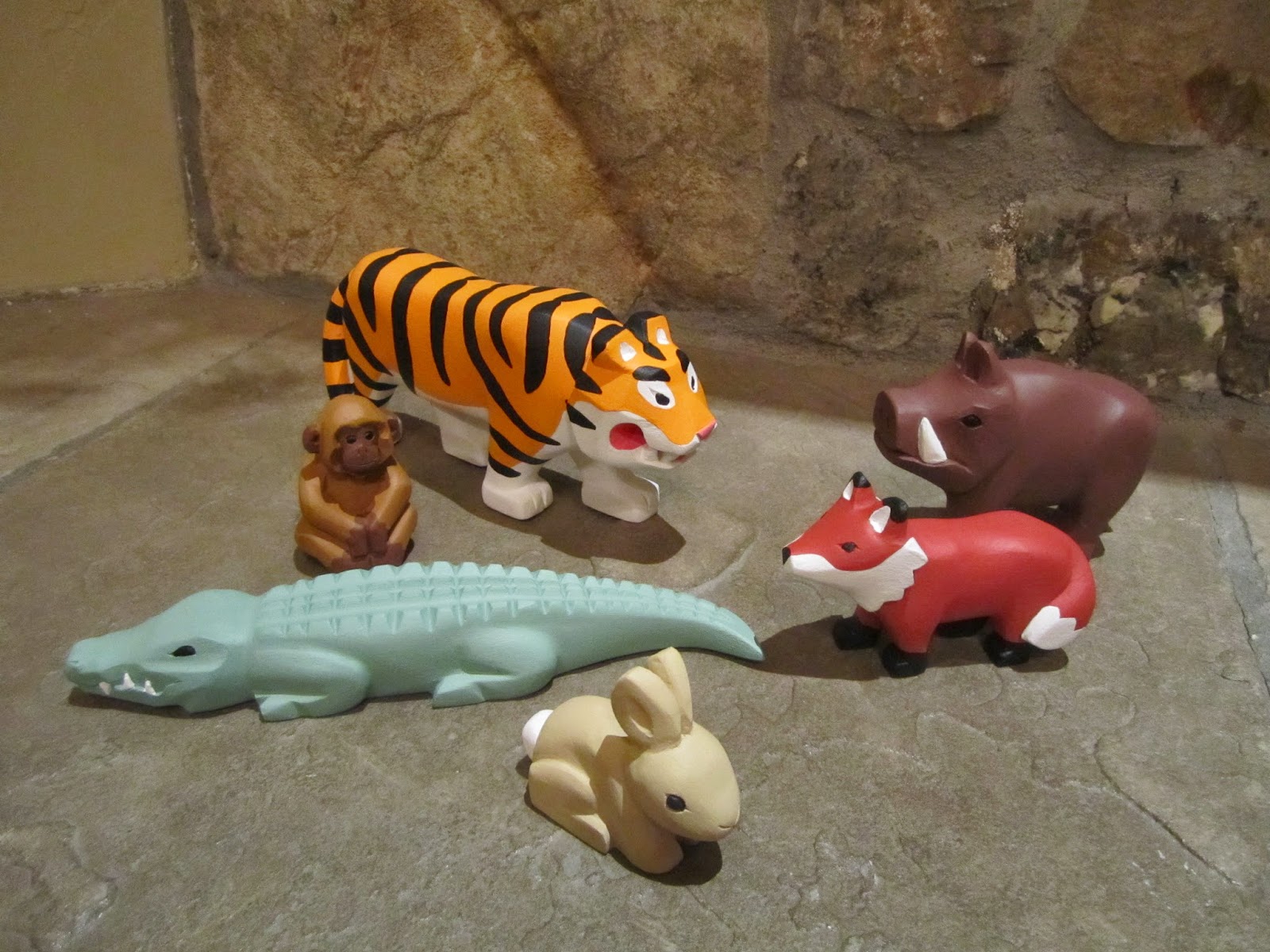
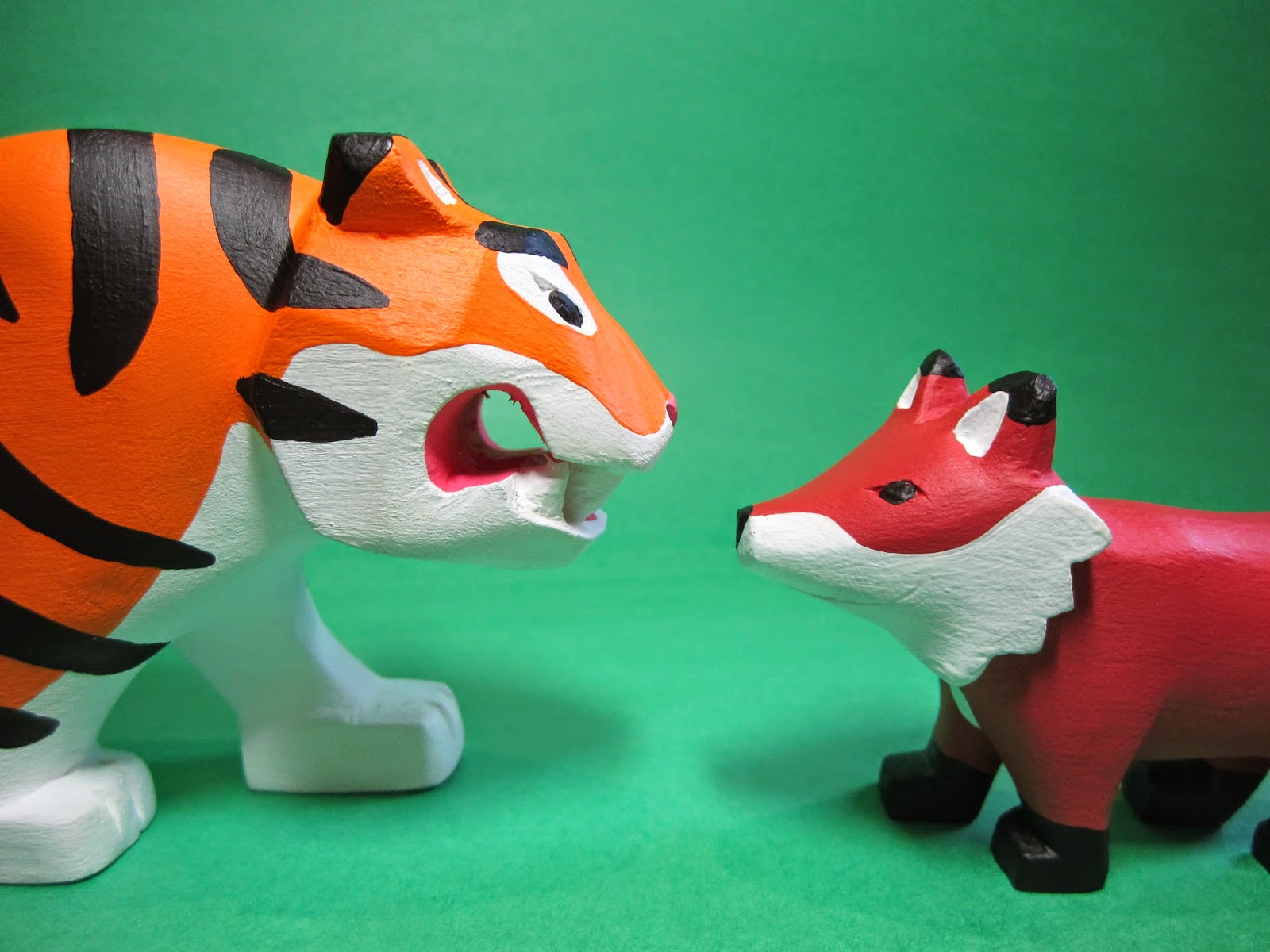
The Fox Borrows the Tiger’s Fierceness

Tiger was hunting in the forest when he spotted a fox just walking around minding his own business.  Mmm, thought Tiger, that fox looks like he would make a tasty snack.  And springing with his powerful legs, Tiger pounced and caught the fox under his large paw.  Fox knew he was in grave danger, but not wanting to be someone’s dinner and being very clever, he thought quickly.

“How dare you attack me!” he cried.

This caught Tiger by surprise, so instead of sinking his teeth into Fox, he asked, “Why shouldn't I enjoy a little snack?  I caught you fair and square.” 

Fox made his voice a little louder and a little bolder and said, “You have no right to kill me!  I am king of the forest.” 

Tiger laughed, “You? King of the forest?  You are nothing more than a scrawny creature--how can you be king of anything?”

Fox was ready with his answer.  “I will prove it to you.  Walk with me in my forest, and you will see how frightened all the animals are of me.  Then you will know that I am king of the forest.”

Now Tiger didn't really believe that Fox was king of the forest, but the little fellow spoke so loudly and so boldly that Tiger wanted to see how the experiment would go, so he released Fox.  Then, Fox, holding his head high, proudly walked deeper into the forest with Tiger right behind him.

After they had gone a short way, Fox called, “Hello!” to a rabbit that was munching on grass.  The rabbit caught sight of Fox (which was frightening enough), and then he saw Tiger following closely behind.  The rabbit’s eyes grew wide, and his ears began to tremble, and he hopped quickly away into the long grass.

Of course that little rabbit would run from Fox, Tiger thought.  Fox would eat him if he got the chance.

So with Tiger still suspicious, the pair walked even deeper into the forest.

“Hello,” Fox called to a monkey that was chattering in the tree tops.  The monkey swung down to chatter at Fox, but when he saw Tiger, his eyes grew wide and his tail began to tremble, and grabbing a kudzu vine, he swung away through the trees.

Tiger thought, Perhaps Fox is fiercer than I supposed.  Still, he can’t possibly frighten all the animals and be king of the forest.

The two continued walking and hadn't gone much farther when Fox called, “Hello!” to a boar that was wallowing in the mud.  “Ugh,” grunted the boar, and looking up, he saw Fox with Tiger walking after him.  The boar’s eyes grew wide, and his tusks began to tremble, and he crashed off into the underbrush leaving a trail of mud behind him.

That is surprising! thought Tiger.  Boar is afraid of Fox.

But before he had time to wonder at the strangeness of it, Fox was greeting a crocodile sunning himself by the river.

“Hello,” called Fox.  And the crocodile turned to snap at the little fox for bothering him while he was enjoying the afternoon sun, but seeing Tiger made the crocodile’s eyes grow wide (just a little), and his thick leathery skin began to tremble (just a little).  And the crocodile slunk slowly into the river and swam away.

Tiger was so shocked, he couldn't say a word, but Fox could.  Fox stood straight and tall, looked up at Tiger and in his boldest voice declared, “You see?  All the animals flee from me.  I am truly king of the forest.”

Tiger had to agree it was true, and bowing his head, he turned and left Fox to rule over his forest.


And that is how Fox borrowed the Tiger’s fierceness.

Saturday, January 31, 2015

January Storytime Briefly 2015

Snow, snow, and more snow--that's what we should be seeing in my neck of the woods around this time of year.  Even though I didn't even pull my snow shovel off its hook in January, that didn't stop me from pulling some snow books off my shelves.

We talked about hats and earmuffs and read
  • Brimsby's Hats by Andrew Prahin and
  • Earmuffs for Everyone: How Chester Greenwood Became Known as the Inventor of Earmuffs by Meghan McCarthy.
Earmuffs for Everyone reminded one student of a book we had read a few months ago--Pop!: The Invention of Bubble Gum.  He was pretty pleased with himself when I pointed out that both were were written and illustrated by Ms. McCarthy.

We talked about snow and read
  • Outside by Deirdre Gill and
  • Snowflake Bentley by Jacqueline Briggs Martin, illustrated by Mary Azarian.
I think those selections left us lamenting our lack of snow, so the next week I changed plans.

We talked about unreliable narrators and read
  • The True Story of the Three Little Pigs by Jon Scieszka, illustrated by Lane Smith and
  • The Bear Ate Your Sandwich by Julia Sarcone-Roach.
We considered the stories' narrators, and compared them to the narrator in a book we had read previously--Jon Klassen's This Is Not My Hat.  If you haven't seen The Bear Ate Your Sandwich, go find a copy now.  You can thank me later.

We read books about science:
  • Gravity by Jason Chin and
  • Star Stuff: Carl Sagan and the Mysteries of the Universe by Stephanie Roth Sisson
We looked at the illustrations and talked about the upcoming ALA Youth Media Awards.  I can hardly wait for next week to share some of the winners!

Thursday, January 1, 2015

Cybils Finalists 2014

Well, I've read my last YA nonfiction book, for this year at least.  Serving on the Young Adult Nonfiction panel for the Cybils has kept me busy for the past few months, and you can see the finalists for that category and all the Cybils categories on their website.  Happy reading!

Monday, December 29, 2014

From Our Bookshelves 2014

If you haven't tired of lists yet, we have one more for you to peruse--our favorites.  These are 2014 books that we read, re-read, shared, and bought for our personal library shelves.  Every title is a keeper!

Picture Books:
Fiction:
Nonfiction:
Poetry:
  • How I Discovered Poetry by Marilyn Nelson, illustrated by Hadley Hooper
  • Firefly July: A Year of Very Short Poems selected by Paul B. Janeczko, illustrated Melissa Sweet
  • On the Wing by David Elliott, illustrated by Becca Stadlander

Friday, December 19, 2014

December Storytime Briefly 2014

This December, I was hoping for a big snow storm so I could have an excuse to share some of my favorite snow books.  But our weather has been unseasonably warm, so I gave up on waiting for snow and read the books anyway.

We talked about snow storms and read
  • Big Snow by Jonathan Bean and
  • Blizzard by John Rocco
I brought one of my favorite childhood books, Katy and the Big Snow by Virginia Lee Burton to show the kids, and we looked at the map of the city and the picture of the snow-covered city.  We discussed similarities in the pictures of David's town in Big Snow.  The students also enjoyed finding the days of the week in the illustrations for Blizzard.

We talked about the Christmas truce during World War I and read
  • Shooting at the Stars: The Christmas Truce of 1914 by John Hendrix
I appreciated the author's note at the end of the story that led to an interesting discussion as we discussed the question many of the students asked: Why didn't the soldiers just make peace if they wanted to stop fighting?

Wednesday, December 3, 2014

Best of 2014 -- More Lists!

Check out three more Best of 2014 lists:

Kirkus Best Children's Books of 2014, New York Times Notable Children's Books of 2014, and Horn Book's Fanfare.

And if you haven't read How I Discovered Poetry yet, you really should.  Love that book!

Sunday, November 30, 2014

November Storytime Briefly 2014

The weather is turning cold, the kids are turning restless, and since we were talking about nonfiction books in the library, I read fiction for storytime.  Although, for one week I did return to what is becoming one my favorite themes: inventions.

We read books illustrated by Jon Klassen:
  • Sam and Dave Dig a Hole by Mac Barnett, illustrated by Jon Klassen;
  • Extra Yarn by Mac Barnett, illustrated by Jon Klassen; and
  • This Is Not My Hat by Jon Klassen.
We talked about the importance of the text and the illustrations in a picture book and how they work together to tell the story.  We also talked about the possible endings for Sam and Dave Dig a Hole.

We talked about inventions with steel.  We read
  • the poem "Skyscraper" by Dennis Lee and
  • Mr. Ferris and His Wheel by Kathryn Gibbs Davis, illustrated by Gilbert Ford.
We talked about the first skyscraper in 1885 that rose 10 stories high and skyscrapers today that reach up over 2,000 feet.  We marveled at Ferris wheel passenger cars that held 40 velvet seats.

We talked about wishing and read
  • The Witch's Walking Stick by Susan Meddaugh and
  • Joha Makes a Wish: A Middle Eastern Tale by Eric A. Kimmel, illustrated by Omar Rayyan.
I asked, "If you had one wish what would it be?"  One student wanted to fly, another wanted to be rich, and then there was my favorite: "I would wish to be a shape shifter."