Showing posts with label middle grade. Show all posts

Wednesday, December 7, 2016

From Our Bookshelves 2016


2016 is quickly coming to an end, and one of our favorite things to do is scour all of the end-of-the-year lists for any favorite books we may have missed.  Are there any hidden gems that have escaped your notice?

Before the year closes, be sure to check out these "Best of" Lists:

Publisher's Weekly's Best Children's and YA Books 2016

The New York Times Best Illustrated Children's Books of 2016
The New York Times Notable Children's Books of 2016

Kirkus Best Middle-Grade Books of 2016
Kirkus Best Picture Books of 2016

Horn Book Fanfare

School Library Journal's Best Picture Books of 2016
School Library Journal's Best Chapter Books of 2016
School Library Journal's Best Nonfiction Books of 2016
School Library Journal's Best Middle Grade Books of 2016

NCTE Orbis Pictus Award for Outstanding Nonfiction for Children
NCTE Charlotte Huck Award for Outstanding Fiction for Children

National Book Awards


And, if that didn't quench your thirst for top books of the year, let us throw our vote it!  These are some of our favorite books from 2016.

Picture Books:
  • They All Saw a Cat by Brendan Wenzal
  • A Well Mannered Young Wolf by Jean Leroy, illustrated by Matthieu Maudet
  • Owl Sees Owl by Laura Godwin and Rob Dunlavey
  • Before Morning by Joyce Sidman, illustrated by Beth Krommes
  • The Princess and the Warrior by Duncan Tonatiuh
Non-Fiction Picture Books:
  • A Poem for Peter by Andrea Davis Pinkney by Andrea Davis Pinkney, illustrated by Steve Johnson and Lou Fancher
  • Some Writer!: The Story of E. B. White by Melissa Sweet
  • Best in Snow by April Pulley Sayre
Fiction:
  • Hour of the Bees by Lindsay Eager
  • The Girl Who Drank the Moon by Kelly Barnhill
  • When the Sea Turned to Silver by Grace Lin
Non-Fiction:
  • We Will Not Be Silent: The White Rose Student Resistance Movement That Defied Adolf Hitler by Russell Freedman
  • Samurai Rising: The Epic Life of Minamoto Yoshitsune by Pamela S. Turner, illustrated by Gareth Hinds

Poetry:
  • When Green Becomes Tomatoes: Poems for All Seasons by Julie Fogliano, illustrated by Julie Morstad
  • Wet Cement: A Mix of Concrete Poems by Bob Raczka

Friday, December 18, 2015

From Our Bookshelves 2015

'Tis the season for many things . . . including end-of-the-year lists.  You'll want to check these lists twice to make sure you didn't miss any of the year's best.

Horn Book Fanfare

Kirkus Best Middle-Grade Books

School Library Journal's Best of 2015

Publisher's Weekly's Best Children's Books

The New York Times Notable Children's Books
The New York Times Best Illustrated Children's Books

National Book Awards


And, finally, here are our favorites of 2015.  These are books that we read, loved, and shared again and again.   We whole-heartily recommend them.

Picture Books:
Fiction:
  • The Nest by Kenneth Oppel, illustrated by Jon Klassen
  • Echo by Pam Munoz Ryan
  • Audacity by Melanie Crowder
  • The Hired Girl by Laura Amy Schlitz
  • Orbiting Jupiter by Gary D. Schmidt
Nonfiction:
Poetry:
  • Over the Hills and Far Away: A Treasury of Nursery Rhymes collected by Elizabeth Hammill, illustrated by more than 70 artists

Friday, October 23, 2015

Spotlight on Fiction 2015

Circus Mirandus by Cassie Beasley

If the stories that Micah's grandfather told him are true . . . if there really is a place where an elephant named Big Jean can do long division, where a French vulture can tell the future, and where an illusionist can make you fell the frosty winds of Antarctica while you sitting in your chair . . . if Circus Mirandus is an actual circus . . . then "that [means] magic [is] real" . . .(17)  and maybe, just maybe, magic can save Micah's dying grandfather.  When Micah's grandfather, Ephraim Tuttle, visited Circus Mirandus as a boy, the Man Who Bends Light promised him a miracle.  He's been saving that miracle for a time when he really needs it, and that time is now.  Micah is certain that if he can get into the circus and talk to the Man Who Bends Light, the Lightbender will save his grandfather.

In alternating chapters, a family mystery slowly unfolds just as the tension in Micah's story builds, creating suspense that will keep readers turning pages right up to the end.  This story is just the right blend of the fantastic and the sometimes difficult realities of the real world.


The Nest by Kenneth Oppel, illustrated by Jon Klassen

The Nest came out just a couple of weeks ago, and it already has racked up five starred reviews.  It is deliciously creepy, not in a blood-and-gore kind of way, but in a get-inside-your-head kind of way.

Steven has been coping with anxiety and bad dreams for a while and now there is more tension at his house because his newborn brother has a rare congenital problem.  Even though his therapist assures him that "what happens in a dream stays inside the dream," Steven's latest dreams with creatures of light that promise to "make things better" seem all too real.  (110, 23)  And in some ways, he wants them to be real.

The first-person telling puts readers right into Steven's thoughts as he struggles to figure out what is a dream and what is reality.  That ambiguity makes this a psychological thriller that you'll read in one sitting.  (I did.)  Oh, and the villain is the most chilling I've met in a long time.  I bet it'll change the way you feel about wasps.


The Hired Girl by Laura Amy Schlitz

Laura Amy Schlitz describes her new book as a "good old-fashioned story" and that is exactly what it is.

Since her mother's death, 14-year-old Joan does all the woman's work on Steeple Farm, and it's hard work: she takes care of the chickens, cleans out the privy, cooks meals for her father and four brothers, does laundry, and puts food by.  When her father decrees that she can no longer attend school and then burns the few books she owns, Joan decides there is nothing left on Steeple Hill for her, and she goes to Baltimore to become a hired girl.  She has little idea what she is getting into, but she is desperate enough to take a chance on a better life.

In Baltimore she  begins a very different life working for a Jewish family.  While she enjoys the conveniences of electricity, hot and cold running water, a dumbwaiter, and a carpet sweeper, Joan works to learn the Jewish rules of kashrut and appease cranky Malka.  But it is the more universal experiences that change her.  She learns to respect people's differences.  She learns about men who are, thankfully, not all like her father, and gets her first kiss.  She learns about meddling (not a good idea to pass on a love sonnet you found to help a relationship along), heartbreak (things don't go well after that first kiss), and forgiveness.

Written as a series of Joan's diary entries, the story is set in 1911 and the relevant social issues of the time--women's rights, class division, religious prejudice, and labor rights--are addressed.  Historical details and content infuse seamlessly into the story; readers will feel like they've been picked up and placed right in Joan's world.

Friday, May 15, 2015

Interview with Author Jen White

In today's post, debut author Jen White discusses her exciting new novel, Survival Strategies of the Almost Brave--a superbly-paced middle-grade adventure with memorable supporting characters and two unbelievably brave (and yet completely believable) sisters.

After her mom dies, Liberty's father shows up in a camper to take Liberty and her younger sister, Billie, for the summer.  At first, Liberty thinks things with her "gone-forever-but-now-he's-back-dad" might work out fine, but when he abandons the sisters at a gas station in the middle of nowhere, she realizes that they are on their own.  As the sisters try to get to safety, some of Liberty's twelve-year-old decisions are ill-advised, but her loyalty to Billie never wavers. 
Q:  Liberty and Billie have a wonderfully strong bond. Did you draw on personal experience to portray their relationship?

A:  I’m sure I did, although it wasn't a conscious decision.  I come from a large family and we are all close in age.  I have two sisters and two brothers.  I am the oldest, so the bossy, controlling part of Liberty I came by naturally.  I also have my own children.  Although, I do feel like Liberty and Billie are their own creations.  When I wrote them I wasn't thinking of a particular person or persons.  They came alive as I wrote and after I finished my first draft I felt like I had a really good handle on who they were and how they behaved.

Q:  Liberty and Billie cross paths with several interesting characters—do you have a favorite?

A:  In some ways they are all my favorites.  There’s a true emotional connection behind each character.  I would say I really loved Star Wars Kid (Roger) and didn't want his story to end.  I hope I can create some form of Roger again in my future writing.  I also loved Lavender Lady and Orson. They made me laugh and were a great duo to write.  And finally, I’d say, I loved Tattoo Guy.  I love him because upon first observation he seems intimidating and scary, but as the book progresses we get the whole picture of who he is (compassionate, funny, and smart).  In the beginning he is not who he seems.  In general, I think this is true of most people.  There is so much more to a person than what we see on the surface.  Deep down everyone has a story that we can relate to.

Q:  Your story presents mental illness with delicacy and candor. Was it difficult to achieve that balance?

A:  Thank you, I’m so happy to hear you say that.  I worked very hard on those scenes and wanted them to feel right.  I would say the moments with Liberty and Billie’s dad were my most difficult to write and I spent most of my time on those scenes trying to make them feel real.  People deal with mental illness daily— trying to cure it or contain it, as well as trying to accomplish everyday tasks such as how to: work, sleep, eat, take care of children, get an education, find someone to love, etc..  In many ways mental illness can feel like business-as-usual for the people who live with it or for people whose loved ones struggle, so I wanted, at times, what was going on with dad to feel both comfortable and uncomfortable to Liberty and Billie.  Obviously, in the book, their dad needs help.  The girls need to get over the dream of who they want him to be and come to terms with who he really is.  They also need to get to a place in the book where they recognize he is not behaving normally.  Sometimes mental illness isn't entirely obvious until, when suddenly, it is.

Q:  What is the hardest part of writing for you? What is the most rewarding?

A:  Right now I can pinpoint two hard parts.  First, forcing myself to create time to write can be difficult for me.  My family is still all at home, so there are many needs at my house.  I am one of the primary people who take care of those needs, so time is my enemy. There is a constant struggle between things that need my immediate attention and also my writing (which also needs my attention, but it doesn't always feel quite as urgent).  When I am not getting my writing time I turn very cranky.  At my house we have this game, Table Talk, that we play at dinnertime and one of the questions is: If you could be a super hero what quality would you have and why?  I always choose the ability to stop and start time.  My kids think that is the WORST super hero power ever.  But wouldn't that be awesome?  I dream of having all the time in the world.  Second, I think the hardest part in a manuscript is generally the middle…I would say around page 130 is where I start to slow down and feel stuck.  That’s because I don’t use an outline as I write.  I’m a seat-of-my-pants kind of writer, so the middle always gets difficult because I have to make important decisions that affect the ending.  I hate middles. The most rewarding part of writing is reading a scene you just wrote and think, wow!  I kind of like that.  In fact, I like it a lot.  That feeling is addictive.

Q:  This is your first published book. Were there any surprises along the journey from idea to publication?

A:  Yes, there were surprises.  I remember going to a marketing meeting at FSG/Macmillan after the book was first bought and someone asked, “Do you have any questions?”  And I sat there trying to think of an intelligent question when I finally said, “I’m sorry.  I don’t know what I don’t know.”  Now, two years into the publishing process, I think I would have better questions.  Another surprise is once your manuscript is bought by a publishing house is takes a REALLY LONG time to hold that book in your hands.  It just does.  There’s no real way around it.  Also, I didn't realize how much I was going to need and rely on my agent who has turned out to be a really amazing person, so I lucked out there.  When I was making my agent choice, I didn't realize how important that relationship would be, and I have been pleasantly surprised.  The same is true for my editor.  I have learned so much from her.  It’s great to work with people who love my book almost more than I do.  The publishing world is really quite small and I think it’s important to surround yourself with great people, and in turn, be good to the people around you.

Thanks Jen, for taking the time to tell us a little about yourself and your book.  I'm looking forward to reading your next book, especially if you tell us more about Star Wars Kid's story.

You can read more about Survival Strategies of the Almost Brave and read the first chapter at Jen White Books.  Pick up a copy of your own when it comes out on June 9.

Monday, August 11, 2014

tara recommends Loot by Jude Watson

"No thief likes a full moon.  Like mushrooms and owls, they do their best work in the dark."  The first lines of Loot by Jude Watson set up a fun heist adventure that will keep you on your toes as you follow the twists and turns through an engaging mystery.

March McQuin's father Alfie, an infamous jewel thief, taught his son all the tricks of his trade while adventuring the world, and they always had each other.  But, when his father slips off a building during a robbery gone bad and dies, March loses the only family he has ever known, and he is truly alone.

Alfie McQuin's dying words were to "find jewels," so March sets off to find his last big score.  He soon realizes, however, that "jewels" is not the fortune he is expecting, but is actually his secret twin sister, Jules and their reunion begins an adventure neither of them planned as they search for seven mysterious moonstones, originally stolen by their father many years ago.  They are pursued by a dangerous thief who will do anything to grab the gems first, and they also must stay a step ahead of an ex-detective with his own agenda.

Peppered with useful hints to be a successful conman -- "Never trust a guy who says, "Trust me."  Never give your real name to a cop.  Never let someone steal your getaway car." -- Alfie's advice is engaging and provides the background for March and Jules' dangerous adventure.

Jewel heists, betrayal, greed and loss mix together with a familiar story about family ties, friendship and love.  While the criminal knowledge and experience of these twelve year olds is a little unsettling, their independence and persistence make for an entertaining adventure.  There are certain scary elements (hooded men chasing the kids through dark streets, fight scenes and death) that skew the story to a slightly older audience.


Loot: How To Steal A Fortune
by Jude Watson
published by Scholastic Press
June 2014
recommended for ages 10 and up

Friday, July 18, 2014

Spotlight on Fiction 2014

Pigsticks and Harold and the Incredible Journey
by Alex Milway

“Pigsticks [is] the last in a noble line of pigs,” but he hasn’t done anything great yet.  After reading about his forepigs, Pigsticks decides to travel to the Ends of the Earth and (“unlike [his ancestor] Colonel Pigslet) . . . make it back alive!”  After a futile search for an assistant, Pigsticks serendipitously meets a small hamster named Harold who is strong, honest, and just what Pigsticks is looking for.

“The job’s yours . . . We shall leave tomorrow, before breakfast!”
“But I’m going to a tea party tomorrow . . . There will be cake.”
“We shall take a cake with us.”
“I don’t mean to be rude . . . but I could never leave before breakfast.”
“We shall take two cakes with us!” (21)

Reluctantly--and only after a promise of three cakes, one of them Battenburg--Harold agrees to the arrangement, and the unlikely pair set off on an adventure.

Pigsticks’ studied inattention, Harold’s penchant for cake, and the dialogue between the two create unpredictable humor and some absurd situations.

An interesting, elevated vocabulary makes this upper-level easy reader a great choice for independent readers who still want shorter stories with plenty of pictures.

*Received Netgalley ebook for review.


Ophelia and the Marvelous Boy
by Karen Foxlee

 “Ophelia did not consider herself brave . . . but she was very curious.  She was exactly the kind of girl who couldn't walk past a golden keyhole without looking inside.” (9)  That keyhole happens to be in a snowy foreign city where her father has just taken a job at the museum. Her mother died three months ago, and since her father is distracted with work, and her sister is moody and distant, Ophelia explores the museum alone.  But the museum is a confusing place with signs pointing the wrong direction and guards that knit, sleep, and yell for no good reason, and of course, that golden keyhole.  Behind the keyhole she finds a 303-year-old boy who claims his name was taken by a “protectorate of wizards from the east, west, and middle . . .” (14) and that he is a prisoner of the Snow Queen.  He needs Ophelia’s help to find a magical sword and the One Other who will know how to wield it.  In short, he needs her to save the world.

Foxlee gives readers a wonderfully wicked villain.  The Snow Queen is “dazzlingly beautiful,” ice cold, deceptively kind, and she smells like hot chocolate. (13)  Eleven-year-old Ophelia Jane Worthington-Whittard is an equally delightful heroine.  She has a pale face, ragged braids, smudgy glasses, and asthma, and she simply refuses to believe in magic.  (Oh, and she likes sardines.) (76-77)

With lyrical writing, an adventure-filled plot, and the triumph of love over misery, this Snow Queen story is everything that a modern-day fairy tale should be.

*Review copy received from publisher.


Half a Chance
by Cynthia Lord

For 12-year-old Lucy Emery, moving to a lakeside cottage in New Hampshire means starting over in a new place again.  While her dad is out of town on another photography assignment, Lucy makes friends with Nate, the boy next door, and together, they spend the summer trying to find the perfect shots for a photo contest that Lucy is determined to win.  They hike a mountain, kayak on the lake, and watch the loons, but when one photograph reveals too much about Nate’s grandmother, it might mean the end of their friendship.

Lucy’s thoughtful observations provide insight into the characters and the human experience.  For instance, Lucy’s thought that kids “care a lot about other people, but most times . . . don’t have the power to change things for them” rings true. (71)  And her reaction to meeting new people (“Practice only makes familiar . . . Never easy.”) made me stop and think what many introverts might think: “Yep! That’s exactly right!” (6)  The sometimes difficult subjects of aging and dementia are treated in a candid, yet sensitive way.

This is a perceptive story about new beginnings, saying goodbye, and all the moments captured in between.


Revolution
by Deborah Wiles

Segregation is a way of life in Greenwood, Mississippi, so 12-year-old Sunny Fairchild doesn't think much about why only white people go to the movies at the Leflore, or why no black children swim at the city pool, or why the only black woman at church is not a congregant, but a nursery assistant.  Besides, Sunny has worries of her own: her mother left when Sunny was a baby and her father’s new wife and children are “stuffed” into her home (80).  But this summer--the summer of 1964--agitators from the North are invading Mississippi, bringing big changes to the South, and as Sunny learns to look beyond her own concerns, she finds herself changing, as well.

Wiles uses Freedom Summer--the summer when 1,000 volunteers descended upon Mississippi and worked in a coordinated effort to empower black residents by registering them to vote--as the setting for her story. 

Revolution is the second book in The Sixties Trilogy, and as in the first book, period photographs, music lyrics, speech excerpts, and brief biographical sections are inserted between pages of story.  The factual--LBJ, Muhammad Ali, the Beatles, escalation of the war in Vietnam, and the murder of three Freedom Summer volunteers--intersects with Sunny’s fictional story, enhancing both and creating a memorable read.
This summer marks the 50th anniversary of Mississippi’s Freedom Summer.  Revolution,  Freedom Summer by Susan Goldman Rubin and the young adult book, The Freedom Summer Murders by Don Mitchell are all excellent for exploring this pivotal period in our nation’s struggle with civil rights.

Tuesday, April 1, 2014

tara recommends Nightingale's Nest by Nikki Loftin

Can a book be both heavy and lift you up?  Is it possible to deal with very hard, serious issues, yet be lyrical and beautiful?  Nightingale's Nest by Nikki Loftin does just that.

Twelve-year-old Little John has some real problems, including dealing with the death of his sister, working alongside an alcoholic father, and trying to negotiate a mentally unstable mother.  To top it off, he also befriends and tries to protect an abused foster child, Gayle, who lives across the street from his father's employer, Mr. King.

Gayle is an unusual child who likes to sing while perched in a self-made nest, high in a sycamore tree.  She is delicate and alone, but when Little John finds her, she lets her guard down and brings him into her world.  When her birdsong voice attracts the attention of creepy Mr. King, the richest man in town, Little John is forced to make some difficult choices.

This strangely beautiful and heartfelt story has some unanswered questions that will leave readers wondering, and there are elements that force you to suspend reality to fully appreciate the journey.  However, responsibility, trust and ultimately forgiveness are expertly woven through a unique narrative that will stay with you and pull at your heart.

Nightingale's Nest
by Nikki Loftin
published by Razorbill
February 2014
recommended for ages 10 and up

Monday, September 2, 2013

diane recommends Kiki Strike by Kirsten Miller

For a very fun, light read, I decided to read the Kiki Strike Series. The reason I really like these books is because they do not have language, but they are still geared to a slightly older audience than my normal middle grade reads.

(On the left, are the original covers to the books. I, personally, like those better than the new ones, on the right, but, if you decide to buy the series, you should get the new ones because the third book only matches the re-done covers.)


Kiki Strike is girl who is a little bit different. She is often described as "elfish" with her pale skin, and her shimmering white hair, but, she is also very pretty, in a different sort of way.

In the first book, Kiki creates a group of friends who call themselves, "The Irregulars" and she takes charge of her group as they start their adventures together. They learn Kiki's true identity, what her mission is, and whether or not they can trust her.

In the next book they continue their adventures together and start to learn things about Oona Wong, the fashion Chinese girl with an attitude. When they discover some dark secrets about her family, they have to decide whether she should be trusted, or whether she is loyal to other people.

And, finally, in the third book, that recently came out, readers learn all about Betty Bent. Betty has her own adventure while the Irregulars can only sit and watch it play out. They discover that being tough is not always the only way to be strong. Being nice is  more courageous at times.


All of the books are written in Ananka Fishbein's voice, and she gives you some nice tips. Although these tips are not necessary to read, and only loosely relate to the book, they are really funny, and they help you understand what Ananka is thinking.
"Test Your Detective Skills
 . . .
The Following test will help you determine whether you're ready for action--or could use a little more practice. Keep in mind--in real life, there are no multiple choice questions.
 . . .
2. What time did your next-door neighbor leave his house this morning?
     a. Exactly ten minutes and eleven seconds later than yesterday
     b. Who knows? I decided to sleep in
     c. I would never intrude on someone's privacy!
     d. Come to think of it, I haven't seen him in weeks. Maybe I should knock at his door"

"How To Plan An Escape Route
 . . .
[These] come in handy when you're avoiding an annoying suitor, evading the authorities, or running from a furious sibling.
 . . .
Wear the Right Things.
Unless you're attending a ball, try to wear clothes that will allow you to move comfortably. In particularly dangerous situations, you may want to choose fabrics such as wool or silk that won't easily catch on fire or melt under extreme heat."

Each book gets a little older, the first book starts out really simple, with a bunch of seemingly little girls. The next one, they are a little bit older, a little more experienced, and you start adding a little bit of boy drama when Kaspar, Betty's soon to be boyfriend, enters the story. By the third one, they have added more boy drama, and a little language. I think that they will probably come out with more books in the series, but I really liked these books because they were language free, so although it will still be a fun, adventurous read, don't count on them being language free from here on.

The only slight problem that I had with the book was that Miller kept foreshadowing and I was very annoyed with it. At the end of the chapter, it would often end with a statement that was going to give away the next part of the book. Personally, I would rather figure it out myself, instead of having it told to me.
"But before the night was over, the Irregulars would discover the terrible price they had paid for their pleasure."

"'I'll wait. It's not that important,' said Oona, and I suddenly suspected it was."
Overall, I really liked these books, and I am still looking forward for the next one to come out.

Kiki Strike: The Darkness Dwellers
by Kirsten Miller
published by Bloomsbury USA Childrens
January 2013

Recommended for ages 11-13

Kiki Strike: The Empress's Tomb
by Kirsten Miller
published by Bloomsbury USA Childrens
October 2007

Recommended for ages 12-14

Kiki Strike: Inside the Shadow City
by Kirsten Miller
published by Bloomsbury USA Childrens
May 2006

Recommended for ages 13-15

Monday, August 26, 2013

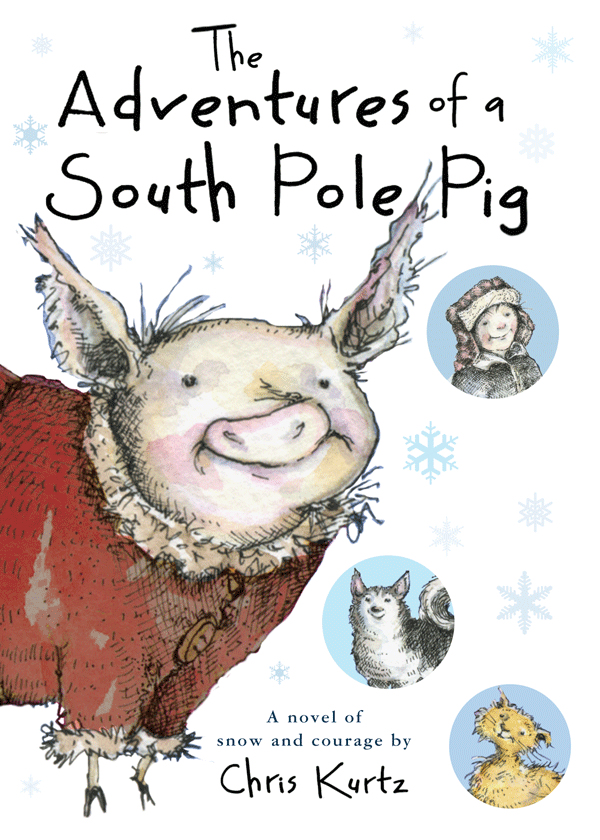
danyelle recommends The Adventures of a South Pole Pig by Chris Kurtz

You know that oft-repeated bit of parenting advice, If your child refuses a certain food, continue to offer it to him and he may develop a taste for it?  Well, although no amount of exposure has helped me develop a taste for mushrooms--no way, no how--I have found that advice to be helpful for not only picky eaters, but for picky readers, as well.  Continue to offer (and sample) a variety of books and before long you'll have a reader with expanded reading tastes.  But, here's my confession:  Besides detesting supposedly-edible fungus, I am also not a fan of talking-animal books.  I can't quite put my finger on the reason for that--after all, it's not as though they have an unbearably squishy texture--but generally, books with animals that talk end up at the bottom of my to-read stack.  So, here we are in August, and I have just gotten around to reading the January release, The Adventures of a South Pole Pig, featuring Flora, a talking pig.

Flora lives with her mother and her brothers in a cage; well, not actually a cage, as her mother points out, "It's a pigpen." (1)  But, it's all the same to Flora who longs to see new things and have adventures.  More than anything, Flora wants to be a part of a dog sled team, so when an opportunity to get out of her pen and join the dogs presents itself, Flora takes it.

Flora tells the story with her consistently upbeat voice and positive attitude.  As she heads to Antarctica believing she will be a sled dog, readers understand that she is being taken on the voyage as food.  This irony creates some amusing situations like the time Flora is chained in the ship's hold, and yet she persuades herself to hold on to her dream.
"Was it possible . . . could she be the precious cargo?  Being put down here had to have something to do with being special.  Or maybe it had to do with the training a sled pig needed.  Yes, that was it!" (90)
With a couple of unlikely friends, Flora discovers how "adventure comes to those who choose it but turns into trouble quick if you don't know how to land on your feet." (46)  And through all that adventure and trouble, she refuses to give up.

Plenty of action that moves the plot along quickly and clever humor that rises above silliness will hold young readers' interest.  But, the best thing about the story is the characters.  Yep, that's right, it's the talking animals:  Oscar, a dog who is "more than a dog"; Sophia, a cat who changes her solitary ways; and Flora, who tries "hard not to be too piglike." (257)  Flora's optimism and her enthusiasm for new experiences make her an irresistible character and make this a book that I'll be re-reading, this time to my kids.

Move this book to the top of your to-read stack today.

The Adventures of a South Pole Pig: A novel of snow and courage
by Chris Kurtz
illustrated by Jennifer Black Reinhardt
published by Houghton Mifflin Harcourt
January 2013
Recommended for ages 7-12

*Chapter 2 makes a great book talk.
**A great read-aloud scene is at the end of chapter 35 when Flora and Oscar talk about sled dogs being "a little crazy".  See pages 259-260.

Friday, July 19, 2013

Spotlight on Middle Grade Books

Starry River of the Sky
by Grace Lin

The moon has disappeared but only Rendi seems to notice, and only he seems to hear the plaintive moaning of the sky each night.  After running away from home, Rendi ended up in the Village of Clear Sky where he is working as a chore boy at the inn.  Rendi wants desperately to forget his past, ignore the “sobbing sky” and get away from this “poor, pitiful” village.  But when the mysterious Madame Chang arrives and begins telling stories, Rendi finds he is soon telling his own story and figuring out what he really wants.

Lin weaves her own versions of Chinese folktales and myths into the story -- “Foolish Old Man Moves the Mountain,” “Why Rooster Calls the Sun,” “Chang’e and Houyi the Archer,” and others -- flavoring it with the traditional while making it her own.  Similar in style to her Newbery Honor book, Where the Mountain Meets the Moon, Starry River of the Sky is a companion book (not a sequel) to that novel.

Framed, full-color, Chinese-style illustrations are interspersed throughout.

Flowing language and stories within a story make this a wonderful choice to read aloud.  Use it as an introduction to Chinese culture or just something different from the more familiar Western tales.


Jinx
by Sage Blackwood

Life in the Urwald is dangerous, and no one knows that better than Jinx whose father was killed by werewolves and whose mother was carried off by elves.  In the Urwald just getting enough food to eat is rare, so when the harvest is poor and there’s a new baby in the hut, Jinx’s stepfather takes him into the woods to abandon him.  Luckily for Jinx, a wizard named Simon finds him, saves him from trolls, and takes him in.  Although Simon is cranky and neglectful, at least he doesn’t hit Jinx (“not even once”) and he bakes pumpkin pies.  It’s a better life than what Jinx had before, that is until the day Simon performs a spell that takes away some of his deep Urwald magic.  Before Simon’s spell, Jinx had the ability to see inside people’s thoughts -- not actually to see what they were thinking, but to see colors and shapes that helped him understand what they were feeling.  When Simon takes this sixth sense, Jinx feels angry and lost, and determined to find a way to get it back, he sets off into the Urwald where he meets two others who are working to undo their own curses.  Together they travel to the very place Simon told him to avoid -- the home of the Bonemaster.

Dialogue, particularly between these three, is smart and funny, and I think it’s the best part of the book.  Fantasy readers will enjoy much that is familiar -- witches, wizards, trolls, werewolves -- and plenty that is fresh in this imaginative tale.  My guess is they’ll be eagerly looking forward to the next book about Jinx due out in January.


One Came Home
by Amy Timberlake

13-year-old Georgie Burkhardt has a head for numbers; she can shoot just about anything with her Springfield single-shot rifle; she’s stubborn, claustrophobic, and smart.  And even though she watched as the town buried the body, she is doggedly determined to prove that her sister is alive, because, as she points out, “My sister would never die and then lie there.  It made no sense.” (6)

The search for her sister brings Georgie more adventure than she bargains for: she faces down a cougar, stumbles upon counterfeiters, and ends up in a shootout.

This story takes place in Wisconsin in 1871 during the largest nesting of passenger pigeons ever recorded.  It’s hard to imagine these large birds filling the sky and, as Georgie describes it, drawing “a shade on the sun” (13) so that in the middle of the day darkness falls.  And it’s hard to imagine a nesting that encompasses 850 square miles.  You won’t see it in your lifetime, but you can see it through Georgie’s eyes.


Zebra Forest
by Adina Rishe Gewirtz

Sixth-grader Annie doesn’t have much adventure in her life.  She lives on the outskirts of the small town of Sunshine with her brother, Rew, and her mentally unstable Gran, who lately has had more bad days than good.  The only excitement Annie has had in the past year is when she watched The Iran Crisis: Americans Held Hostage with Ted Koppel on TV at her friend’s house.  Now it is summer, her friend is at camp, and the most exciting thing Annie has to look forward to is spending the summer afternoons reading and making up stories with her brother in the Zebra Forest -- a stand of white birch and chocolate oaks behind their house.  Then one night, Annie hears a rattling at the back door.  An escaped prisoner comes out of the Zebra Forest, forces his way into their kitchen, and holds Annie and Rew hostage.

What happens next changes not just their summer, but their lives.  Family secrets are exposed and each member must find a way to deal with those revelations.  At times suspenseful, always thoughtful, this story explores anger, mistakes, responsibility, and forgiveness in a way that is both emotionally honest and powerful.

Saturday, July 6, 2013

diane recommends P.S. Be Eleven by Rita Williams-Garcia

This is the sequel to One Crazy Summer, which came out in December of 2011. It is about three black sisters going through their lives. I would highly recommend reading One Crazy Summer first, before reading this book, or it will be a little confusing.

Three sisters, Delphine, Vonetta, and Fern, have been staying at their mother's house over the summer. They were just starting to build a relationship with their mom, when they had to go back home. At home, their life is a little different. Their black grandma is in total control, except when their dad decides to disagree with her, which is a very rare occasion. As they are picked up at the airport, they are painfully reminded how old-fashioned their grandma is, as she scolds them for making a, "grand negro spectacle" and expects them to apologize to rude white girls.

Delphine, the oldest of the three sisters, has a huge responsibility to take care of her sisters, but she has other problems of her own. Her sisters are growing up, and that is hard for her, but what is even harder, is she is growing up with them. As the story goes on these sisters try to maintain, or maybe improve, their fragile relationship with their mom by writing her letters. But, hard times always come, and Delphine is in sixth grade, which means she will have to worry about the upcoming dance, and her dad getting remarried to a woman that is the opposite of her mom. As Delphine works out all of these problems, her luck doesn't get better. Thing after thing goes wrong, including her teacher not being the groovy lady she thought she would have, but an out of country weird man.

My favorite parts of this book were the letters to and from their mom.
Dear Cecile,
 . . . Did you love my father? Did he love you? . . .
Yours truly,
Delphine
Dear Delphine,
 . . . Don't concern yourself with old things. Concern yourself with finding you own thing. But don't rush. Listen to Billie sing, "God bless the child who has her own." Enjoy the time it takes you to find your own. Study hard.
Your Mother.
Cecile
P.S. Be eleven.
Because Delphine is eleven, she can't figure out why her mom continually puts, "P.S. Be eleven." at the end of almost every letter. But, later in the story, she starts to figure out what that really means.

This is a good book because you discover yourself in Delphine as she figures out her life. Overall, I was satisfied with P.S. Be Eleven, and I am looking forward to the next book.

Review copy received from the publisher.

P.S. Be Eleven
by Rita Williams-Garcia
published by Amistad
June 2013
Recommended for ages 9-11

Wednesday, June 12, 2013

tara recommends Jinx by Sage Blackwood

Life in the Urwald is dangerous and even the youngest children know it is treacherous to stray off the path.  In a land threatened by trolls, werewolves, werebears, firebirds, and elves - you have to grow up quickly in order to survive.

Jinx is a young boy who is not wanted by his stepparents and no matter how little he eats or how much he works, he is a definite inconvenience.  So one day, his stepfather takes him into the Urwald with the clear intention to abandon him there.  Unfortunately for Bergthold (the stepfather), once he steps off the path, he loses his way and can't find his way back.  As they are wandering around the forest, they run into a wizard harvesting mistletoe who is easily able to discern the troubling situation.  He offers to buy the boy and in the next moments, Jinx steps into a new fate.

The only wizard Jinx knows of is The Bonemaster, and he is not somebody you would want to cross.  In fact, the rumor is that he "sucks out people's souls with a straw."  Luckily for Jinx, he has a special ability to see people's thoughts in colors around their heads, and this wizard's (Simon) weren't "red and angry" but, were "green and blue" and seemed fairly safe.

While Jinx is living with Simon, he works for him and learns a little bit of magic.  And, even though Simon is gruff and secretive, "the thing that Jinx liked most about Simon, besides his cooking, was that he never hit Jinx at all.  Not once."  Clearly Jinx is not used to a safe, inviting environment, and even with witches visiting and Simon leaving for long periods of time - he has found a place to call home.

Simon's motives are always a little questionable, but when he takes Jinx's magic away, Jinx decides to set out on his own to try to get it back.  His journey unites him with Reven, a boy who speaks like an old fairy-tale prince using phrases like "a damsel in distress" and "Fear not, fair maiden!  We shall save you."  They meet up with Elfwyn, the girl in a red-hooded cape who is on her way to her grandmother's house (her grandmother also just happens to be a witch).  Elfwyn tells anybody who asks the frank truth and Jinx often finds himself regretting telling her anything important.

This story definitely plays on our well-known fairy tales (Hansel and Gretel, Little Red Riding Hood, etc.), but the elements that are familiar to us are twisted around in a tale of adventure and magic.  The origins of most of the characters are not fully developed, leaving plenty of room for more books in this series and they all have their own stories to tell.

Overall, this was a fun fantasy adventure with some darker magical elements.  Luckily, it had plenty of comic relief with Reven and Elfwyn's unpredictable behavior and their search to remove their own mysterious curses.  If you are a lover of fantasy, parts of this may feel familiar, but overall a fun read with interesting characters.

Jinx
by Sage Blackwood
published by Harper Collins
January 2013
Recommended for ages 8 and up

Tuesday, May 21, 2013

diane recommends A Corner of White by Jaclyn Moriarty

Well, it has been a long time since I have posted. With the end of the school year coming, and all the general craziness that comes with it, my life has been too busy to pick up a good book. However, that said, once I started this book, I knew that my projects and tests were going to have to wait.

This book has two plot lines running through it, so, instead of trying to intermingle my summary of the two lives, I will just separate them, but, you should be aware that they are intermingled.

Madeleine Tully is a fourteen year old girl living in England. She, once upon a time, had money, but that time has passed. And, now she finds herself in a new place, which she finds very "grey", and ordinary. One day, she finds a note slipped in a sidewalk crack by a parking meter. It reads, "Help, I am being held against my will." She thinks this is a little strange and starts writing notes back. She is not quite sure what to think when the person who responds claims that he is from a kingdom called Cello. The entire time she is writing notes back and forth with this mysterious person, her mother appears to be getting crazier. She is not quite sure what to do with her now up-side-down life, and has to find ways to cope.

Elliot Baranski is a fifteen year old boy from the kingdom of Cello. He is an everyday adventurous boy who goes out to find his missing dad. In this kingdom, magical things happen all the time. They have all of the fairy tale creatures that you dreamed up as a kid, and more. The kingdom of Cello appears to be in a dome of some sort, keeping it separate from the world. But, on occasion, this dome is known to have cracks in which you can communicate with the world. One day, while cleaning out his father's old workplace, he finds a note in a broken TV. When he reads it, he finds a most confusing note that mentions a girl who is "also being held against her will". He starts to write back to her, and realizes that she is from the world, only she doesn't think that he is telling the truth. She does not seem to not know about the kingdom of Cello, and keeps pretending that he is making up his own little world in his head. With this turn of events, he learns who he is, and who he can really trust.

This book is really voicey. And, it really is a "hoot" to read out loud.
"Writing now from the Emerald Carriage, Ko and I (for it is I, Princess Jupiter, who writes this passage)--are thrown back and forth, our glasses of bubbling teakwater spilling so--ah! there goes a drip smudging the paper!--can you see it?! [Editor's note: For obvious reasons, you cannot.] . . . WHO WILL BE NEXT?! Only one more person to choose! Could it be somebody we are going to meet this very day? . . . Or could it be you, sweet reader?! (Assuming you are young. I suppose older people read this paper too. Yes. They would.)"

With all of the voice, and the mystery of the book, with a few facts mixed in, this book keeps you wary of what might happen next. I especially like how trendy this book is. So, if you were looking for a classic, this is far from one, but, it is a really good book. A lot of people reviewing the book are saying that it is for younger YA, but it is not. I would give it to a 6th grader, and expect them to enjoy it. So, for grade designation, I would put it at 5th-7th grade. Any older than that, and they probably won't appreciate the quirkiness of the book.

I just want to put in a little "hooray!" for the cover. Madeleine looks just like she should look. Her outfit is word for word correct, except the omitted head band, and the age is just a little bit old, but close enough. This is the best cover I have seen all year! But, you shouldn't judge a book by its cover.

A Corner of White
by Jaclyn Moriarty
published by Arthur A. Levine Books
April 2013
Recommended for ages 10-13

Wednesday, March 27, 2013

diane recommends Nobody's Secret by Michaela MacColl

Nobody's Secret is a fiction book about Emily Dickinson as a young fifteen year old. Although I liked the plot, the character was not what I was expecting. When I hear Emily Dickinson, I see the little old lady who only wore white dresses and never left her house. So, as a teenager, I would imagine her to be a little more restrained than this Emily is. This Emily is a very daredevilish, headstrong teenager. So, not quite what I was expecting, but, once I got over my preconceptions, this book was amazing.

As a teenager, Emily's adventuresome attitude on life is believable, and very relatable.  MacColl manages to catch the voice of a rebellious teenager perfectly.
"'Miss, I'm sorry for making such a spectacle of myself.' 'So you should be, silly girl,' Emily said, not unkindly. 'Here, sit down and churn the butter; that will calm your nerves.' Under her breath she said, 'It always deadens mine.' Gulping, Mary Katherine nodded."
Emily doesn't want to do the tedious jobs of a housekeeper forever, so, she keeps slipping out of the house to dawdle and smell the flowers. While out, she meets a stranger, who also happens to be really cute, and then her life starts to become more problematic as she discovers secrets she can't trust anyone else to know.

This book is full of mystery, and suspense. You never can guess what strange thing she will discover next, or who might be the problem. I enjoyed this book, but if you read this expecting Emily Dickinson, you might be a little surprised to find that Emily is not the reserved person you thought she would be.

So, I would definitely recommend this book. It was well written, and it captures the attitude of any defiant teenager as they try to do what they want, and not what others think they should do.

Review copy received from the publisher.

Nobody's Secret
by Michaela MacColl
Published by Chronicle Books
March 2013
Recommended for ages 11-16

Wednesday, March 6, 2013

Coincidentally Speaking

Noting similarities in recently published children's literature, book-watchers periodically engage in discussion and speculation about trends: middle-grade novels about bullying, young adult books starring vampires, a near ubiquity of bears in picture books, or fairy tales re-imagined for all ages.  But what about similarities that are limited to a couple of books--not a trend by any means--but certainly a curious coincidence?  Just for fun, let's look at a few similarities in books published this year.

Search for a Missing Family Member
  • In Navigating Early by Clare Vanderpool, Early searches for his brother who was presumably killed in the war.
  • Georgie searches for her sister even though the town has held her funeral in One Came Home by Amy Timberlake.
  • When Early's dad disappears, she tries to find him in Blue Baillett's new book, Hold Fast.  And while we're on the subject . . .
Characters Named Early
  • In Navigating Early, Early is a boy who has an unusual way of looking at numbers.
  • And in Hold Fast, Early is a girl who has a way with words.  Different, but still similar.
The Bad Guys Are Counterfeiters
  • Counterfeiters try to steal Lincoln's body in an attempt to use it as ransom to negotiate the return of their engraver in Lincoln's Grave Robbers by Steve Sheinkin. 
  • In One Came Home, Georgie stumbles upon counterfeiters as she searches for her sister.
Inclusion of Recipes
  • Patricia Reilly Giff's book, Gingersnap, features Jayna who makes amazing soup.  Recipes included.
  • A Tangle of Knots by Lisa Graff features eleven-year-old Cady who has an amazing cake-baking talent.  Recipes included.
Treasure Island Readings
  • Summer reads passages from Treasure Island to kids at the shelter in Hold Fast.
  • Annie reads passages from Treasure Island to her brother, Rew, in Zebra Forest by Adina Rishe Gewirtz.
1918 Influenza Pandemic
  • In the Shadow of Blackbirds by Cat Winters is set in 1918 San Diego where residents limit travel, cover their faces in masks, and eat large amounts of onions in an attempt to ward off the deadly Spanish influenza.
  • Written in Stone by Rosanne Parry shows some of the aftermath of the 1918 flu that killed Pearl's mother and sibling.
  • In Hattie Ever After by Kirby Larsen, Hattie remembers the Spanish influenza that killed Mattie in Hattie Big Sky.
Con Artists
  • Mary Shelley Black has to figure out whom she can trust in a city plagued by fear and fraud in In the Shadow of Blackbirds.
  • Hattie, in Hattie Ever After, has to figure out whom she can trust when some of those closest to her take advantage of her. Similarities here seem inevitable since both stories are set in the Golden Age of Con.
Ok, there's a sampling of coincidences from this year's books.  Admittedly, some are stronger than others, but I think they are all fun to consider.  What did I miss?

Monday, February 25, 2013

tara reviews A Tangle of Knots by Lisa Graff

Books definitely come out in waves.  While not necessarily original topics, subjects tend to reemerge and ride the popularity train while they can.  The perfect example would be the vampire phenomenon, which has come back into vogue with Stephanie Meyers and Twilight.  Who can blame authors and publishers for providing what readers want?  The trick is to publish early enough in the game, before overexposure takes over and ruins the market.

When I read the synopsis for A Tangle of Knots and saw that it involved special "talents," I instantly thought of Graceling and Savvy - both of which have characters that are born with, or later develop, unique abilities.  Because of this, I was afraid it was going to feel very familiar, and in some ways it did.

The story revolves around eleven-year-old orphan, Cady, who has a remarkable talent for baking delicious cakes that perfectly match the recipient.  Actually, the story has so many characters, it is hard to say who is the main character.  There are nine main characters, all introduced with their own chapters at the beginning of the book.  Each character seems to have a problem they are trying to sort out - and throughout the story, a mysterious man with a talent for tying knots and a fascination with powder-blue suitcases appears to flash a grin "that suggested he knew more about the world than he was letting on" and helps the characters work out their Fate (131).  

Cady's story also includes the recipes for each cake she makes, (reminiscent of Gingersnap, Everything On a Waffle, One Year In Coal Harbor, to name a few).  Cady is a likeable character because her only desires are to make people happy with her cakes and to finally be adopted.  The other players in the story include Mr. and Mrs. Asher and their three children:  Will (whose talent is getting lost), Zane (with a talent for spitting) and Marigold (who is desperately trying to figure out what her talent is).  There is also Mrs. Mallory, who runs the orphanage and V, who was in an accident and can't speak. 

The premise is interesting and the story has a real element of mystery, complete with a creepy "Owner" with an equally unsettling talent, and his hapless errand boy, Toby, who has seen happier days.  There are so many characters and plot lines introduced, that it seems unlikely that they would tie together.  Luckily, by the end most of the questions that pop up are answered, although, a lot of the pieces don't entirely fit into place.  The charm of this book is how the seemingly unrelated characters are woven together with a common thread and with each revealed secret they are more tightly tied together.  

A Tangle of Knots
by Lisa Graff
Published by Philomel
February 2013
Recommended for ages 8 and up

Tuesday, February 12, 2013

tara recommends The Runaway King by Jennifer A. Nielsen

I thoroughly enjoyed The False Prince when it came out last year and have been eagerly awaiting its sequel.  I expected adventure and a fast-paced plot.  I anticipated the continuation of richly drawn characters and unexpected twists and turns in the story.  But, what really made The False Prince so fun to read, was its main character, Sage – so, I mostly was looking forward to more of his mischievous wit, reckless abandon, and total disregard for doing what was expected of him.  I was not disappointed.


If you haven’t read The False Prince, pick it up before you read any reviews so you can be fully immersed in the story without any spoilers.  Because, even though the final twist seems pretty obvious to an adult, the foreboding hints should keep a younger reader engaged, figuring out the story as it unfolds.  

The Runaway King was everything I expected it to be, not the least of which was the development of Sage’s (i.e. Jaron’s) character as he struggles to be king amidst intense opposition and betrayal.  The story begins with the newly crowned Jaron struggling to gain respect from his regents and his people, as he narrowly avoids an assassination attempt and tries to stop the obvious war advancing on Carthya.  Unfortunately for him, nobody else can see the danger, and the regents ship him away with plans to name a steward to rule the country in his stead.  Of course, Jaron will do everything he can to save his throne and his people - so, keeping in perfect character, he comes up with a reckless plan and sets out to see it through – alone. 

This book pulls in all the elements of a good adventure – fighting, pirates, greedy kings, beautiful princesses, danger, and a main character with a wicked sense of humor.  At one point in the story when Jaron has sustained a particularly painful injury, he is asked, “How does it feel?” and with utter sarcasm, he replies, “Like butterfly kisses, what do you think?”   That is just a taste of his flair for getting into trouble and his typical contrary response and devil-may-care attitude. 

The fun of this book is trying to figure out how Jaron will dig himself out of every danger he jumps into (including joining up with pirates) and hoping he can make things right as he burns bridges with every friend he has ever had – all while he is fighting to save his kingdom and stay alive.  I am definitely looking forward to Book 3 in the trilogy to continue in this vivid world with such spunky, flawed, but ultimately relatable characters.

Review copy received from the publisher.

The Runaway King
by Jennifer A. Nielsen
Published by Scholastic Press
March 2013
Recommended for ages 10 and up

Saturday, February 2, 2013

danyelle recommends One Came Home by Amy Timberlake

I'm not exaggerating when I say that visiting the ALA's exhibit floor last week in Seattle was exhilarating.   There is something about stacks of new books that makes me want to celebrate.  And while my plane ride home from Seattle (picture closed airports, circling in the air, diversion to Boise, a long wait on the runway) was miserable, my flight to Seattle was quite enjoyable because I took along one of those new books, Amy Timberlake's One Came Home, to read on the flight.  (Also, I had excellent company.)

After Georgie's sister, Agatha, goes missing, Sheriff McCabe brings back a body, and the town mourns Agatha's death.  But Georgie isn't so sure that her sister is dead, and she runs away to look for her in the last place anyone saw Agatha alive, Dog Hollow.  When she tries to buy a horse from Billy McCabe, she confides her plans to him, and Billy, much to Georgie's chagrin, decides to join her on the journey.  Billy knows that Agatha, his one-time sweetheart, is dead, and Georgie is just as certain that her sister is alive, and as they travel, the two spar, but they also develop a friendship that is tested as secrets are revealed.  Through flashbacks, the reader glimpses events leading up to Agatha's departure and realizes that there is much that Georgie doesn't understand.  Her search for answers takes her on an adventure that includes confronting a cougar, an encounter with counterfeiters, and a good ole' western shoot-out.

The story is set in 1871 Placid, Wisconsin, and as you might expect, Timberlake composes her setting with scenes of the Wisconsin River, hills that "push out of the ground for no discernible reason," and small frontier towns (143).  But more intriguing is the wild (passenger) pigeon nesting of 1871-- the largest recorded nesting -- that is the backdrop for the story.  Timberlake describes the sound, the smell, and the spectacle of innumerable birds hovering "over the woods in a thunderhead."  Readers are treated to a picture of  something they can only imagine: "The sky was a feathered fabric weaving itself in and out, unraveling before my eyes" (13).  Here are time and place masterfully depicted.

All this is related by 13-year-old Georgie, the story's narrator.  Smart, sensible, determined, and independent, she is also self-absorbed, scared, and claustrophobic, and, at times, she allows what she wants to be true to cloud her judgment of what is true.  Georgie says that she is "the rock that started the landslide" and the guilt she feels at that, makes her even more determined to find Agatha alive (176) .  In the first chapter, she makes a convincing case for why her sister "would never die and then lie there," but after a frustrating search, she is convinced ("for the most part, probably, almost certainly, yes surely") that Agatha is dead with "a d at the beginning, a d at the end. No forward or backward." (6, 133)  Early in their journey, Georgie determines Billy's reason for accompanying her, reevaluates her decision when they get to Dog Hollow, and finally, discovers the truth at the journey's end.  Georgie's voice radiates certainty, insecurity, and thoughtfulness.  I loved travelling with her.

With One Came Home, 2013 is off to a great start.

Review copy received from the publisher.

One Came Home
by Amy Timberlake
published by Knopf Books for Young Readers
January 2013

Recommended for ages 9 and up