Showing posts with label nonfiction. Show all posts

Wednesday, December 7, 2016

From Our Bookshelves 2016


2016 is quickly coming to an end, and one of our favorite things to do is scour all of the end-of-the-year lists for any favorite books we may have missed.  Are there any hidden gems that have escaped your notice?

Before the year closes, be sure to check out these "Best of" Lists:

Publisher's Weekly's Best Children's and YA Books 2016

The New York Times Best Illustrated Children's Books of 2016
The New York Times Notable Children's Books of 2016

Kirkus Best Middle-Grade Books of 2016
Kirkus Best Picture Books of 2016

Horn Book Fanfare

School Library Journal's Best Picture Books of 2016
School Library Journal's Best Chapter Books of 2016
School Library Journal's Best Nonfiction Books of 2016
School Library Journal's Best Middle Grade Books of 2016

NCTE Orbis Pictus Award for Outstanding Nonfiction for Children
NCTE Charlotte Huck Award for Outstanding Fiction for Children

National Book Awards


And, if that didn't quench your thirst for top books of the year, let us throw our vote it!  These are some of our favorite books from 2016.

Picture Books:
  • They All Saw a Cat by Brendan Wenzal
  • A Well Mannered Young Wolf by Jean Leroy, illustrated by Matthieu Maudet
  • Owl Sees Owl by Laura Godwin and Rob Dunlavey
  • Before Morning by Joyce Sidman, illustrated by Beth Krommes
  • The Princess and the Warrior by Duncan Tonatiuh
Non-Fiction Picture Books:
  • A Poem for Peter by Andrea Davis Pinkney by Andrea Davis Pinkney, illustrated by Steve Johnson and Lou Fancher
  • Some Writer!: The Story of E. B. White by Melissa Sweet
  • Best in Snow by April Pulley Sayre
Fiction:
  • Hour of the Bees by Lindsay Eager
  • The Girl Who Drank the Moon by Kelly Barnhill
  • When the Sea Turned to Silver by Grace Lin
Non-Fiction:
  • We Will Not Be Silent: The White Rose Student Resistance Movement That Defied Adolf Hitler by Russell Freedman
  • Samurai Rising: The Epic Life of Minamoto Yoshitsune by Pamela S. Turner, illustrated by Gareth Hinds

Poetry:
  • When Green Becomes Tomatoes: Poems for All Seasons by Julie Fogliano, illustrated by Julie Morstad
  • Wet Cement: A Mix of Concrete Poems by Bob Raczka

Friday, December 18, 2015

From Our Bookshelves 2015

'Tis the season for many things . . . including end-of-the-year lists.  You'll want to check these lists twice to make sure you didn't miss any of the year's best.

Horn Book Fanfare

Kirkus Best Middle-Grade Books

School Library Journal's Best of 2015

Publisher's Weekly's Best Children's Books

The New York Times Notable Children's Books
The New York Times Best Illustrated Children's Books

National Book Awards


And, finally, here are our favorites of 2015.  These are books that we read, loved, and shared again and again.   We whole-heartily recommend them.

Picture Books:
Fiction:
  • The Nest by Kenneth Oppel, illustrated by Jon Klassen
  • Echo by Pam Munoz Ryan
  • Audacity by Melanie Crowder
  • The Hired Girl by Laura Amy Schlitz
  • Orbiting Jupiter by Gary D. Schmidt
Nonfiction:
Poetry:
  • Over the Hills and Far Away: A Treasury of Nursery Rhymes collected by Elizabeth Hammill, illustrated by more than 70 artists

Friday, October 23, 2015

Spotlight on Nonfiction 2015

Drowned City: Hurricane Katrina & New Orleans by Don Brown

Most teenagers won't remember ten years ago when Hurricane Katrina pounded New Orleans, after they read Don Brown's account in Drowned City, they won't likely forget it.  The account starts with an African breeze that grows to a category three storm over the Atlantic.  By the time Katrina hits just east of New Orleans, it has slipped to a category three storm, but still it breaks levees, floods the city with one million gallons of water per minutes, and leaves 80% of the city under water.

In this graphic novel readers see the dramatic story unfold across the pages.  Illustrations of people standing, slumping, leaning, and trying to escape the water are filled with desperation and humanity.  And it's the impact of the storm on those people that drives the story.  We see 20,000 people packed into the Superdome with no electricity, no sanitation, and insufficient food and water.  We see a man hold a baby above the floodwaters as he tries to escape.  We see a couple race up the stairs of their home just ahead of the water.  They use a knife to scrape a hole in the roof and get out just in time.  We see people stranded on rooftops surrounded by rising floodwaters.  And we see those that don't make it.

Brown brings readers right into the disaster, recounting the many failures: 360 city buses don't show up to evacuate residents; empty trains leave the city; police abandon their post; there is a lack of communication and coordination between government agencies; there is looting and shooting; more than 1400 people die.  He also describes the rescue efforts of individuals and agencies.  Despite stagnant water teeming with garbage, oil, poisonous snakes, and dead bodies, more than 40,000 people are rescued.

This accessible account leads readers into complex ideas and questions.  What could the government have done better?  Where does responsibility to protect people from natural disasters lie?  How far should society go to protect individuals who choose to stay in harm's way?  What role did race and poverty play in the government response to the disaster?

Brown incorporates quotations from survivors and includes meticulous annotations and bibliographic information.

This is a power book.


The Boys Who Challenged Hitler: Knud Pedersen and the Churchill Club by Phillip Hoose

I've always admired the Danish Resistance during World War II, particularly the heroic transport of most of the Danish Jews to Sweden before they could be rounded up by the Nazis.  What I didn't realize until I read this book is that the Resistance had a slow start.  While fearful and overwhelmed adults in Denmark capitulated to German demands, a small group of young boys fought back.  14-year-old Knud Pedersen and his brother Jens, along with a few of their friends, were disgusted with Danish leaders, and admired the way Norway was fighting against the German.  In broad daylight, they fought by twisting traffic signs and spraying walls with blue paint.  Their activities escalated to sabotage, arson, and stealing weapons.  They called themselves the Churchill Club and their actions inspired others to resist and the Danish Resistance grew.

Engrossing from page one, Hoose's account is based on extensive interviews with Knud Pedersen.


Terrible Typhoid Mary: A True Story of the Deadliest Cook in America by Susan Campbell Bartoletti

When George Soper was hired to figure out the source of a typhoid outbreak that infected six members of the Warren household in 1906, his investigation led him to Mary Mallon, a cook who had infected at least 24 people.  Mary turned out to be the first documented healthy typhoid carrier in the United States.

In this highly readable biography, Susan Campbell Bartoletti looks at Mary's plight.  She was not just "a living culture tube" or "a chronic typhoid germ producer" as George Soper called her, but she was also an intelligent, fiery tempered, fiercely private, independent, Irish woman who didn't accept Soper's assertion that she was making people sick.

This book and Gail Jarrow's superb book, Fatal Fever: Tracking Down Typhoid Mary, look at the same subject.  While Jarrow follows Soper's investigation of the medical mystery, Bartoletti's focus is on Mary.  Together these books make an excellent choice for student analysis of the different approaches authors take in texts with the same topic.

Friday, November 28, 2014

When All Is Said and Done . . .

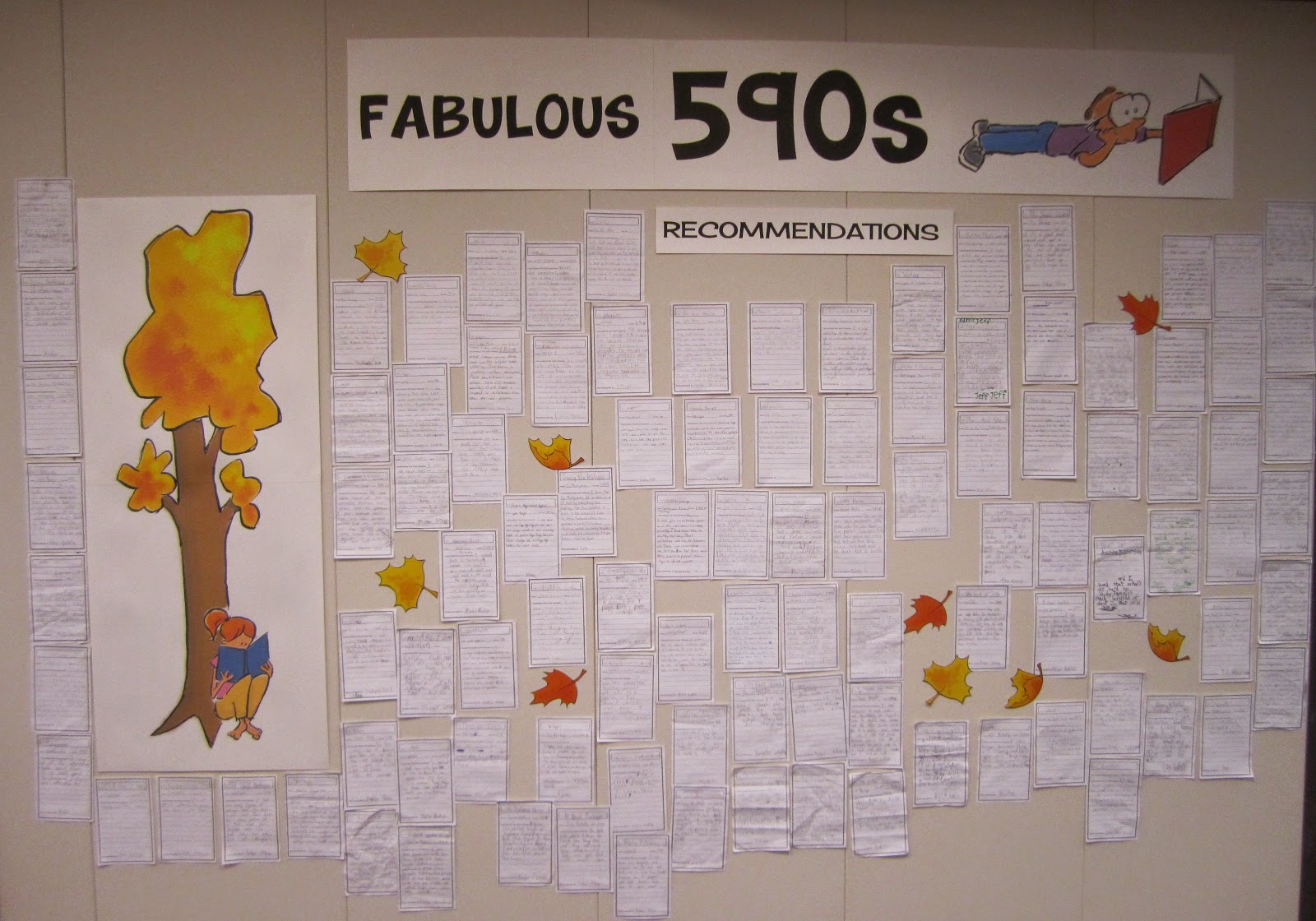
We had a great month reading and re-reading the animal books in our library, and as we wrap up our Fabulous 590s, we consider, Was it a success?  Every book we booktalked was checked out and some now have multiple holds on them.  We filled our wall with student recommendations.  Students crowded around our 590s section and left our shelves depleted.  But the real questions in my mind are these: Will students choose nonfiction books for leisure reading in the future?  Will they continue to check out these excellent books in the months ahead?  Will the current enthusiasm build into a life-long love for some students?

Here's hoping the answers are Yes!


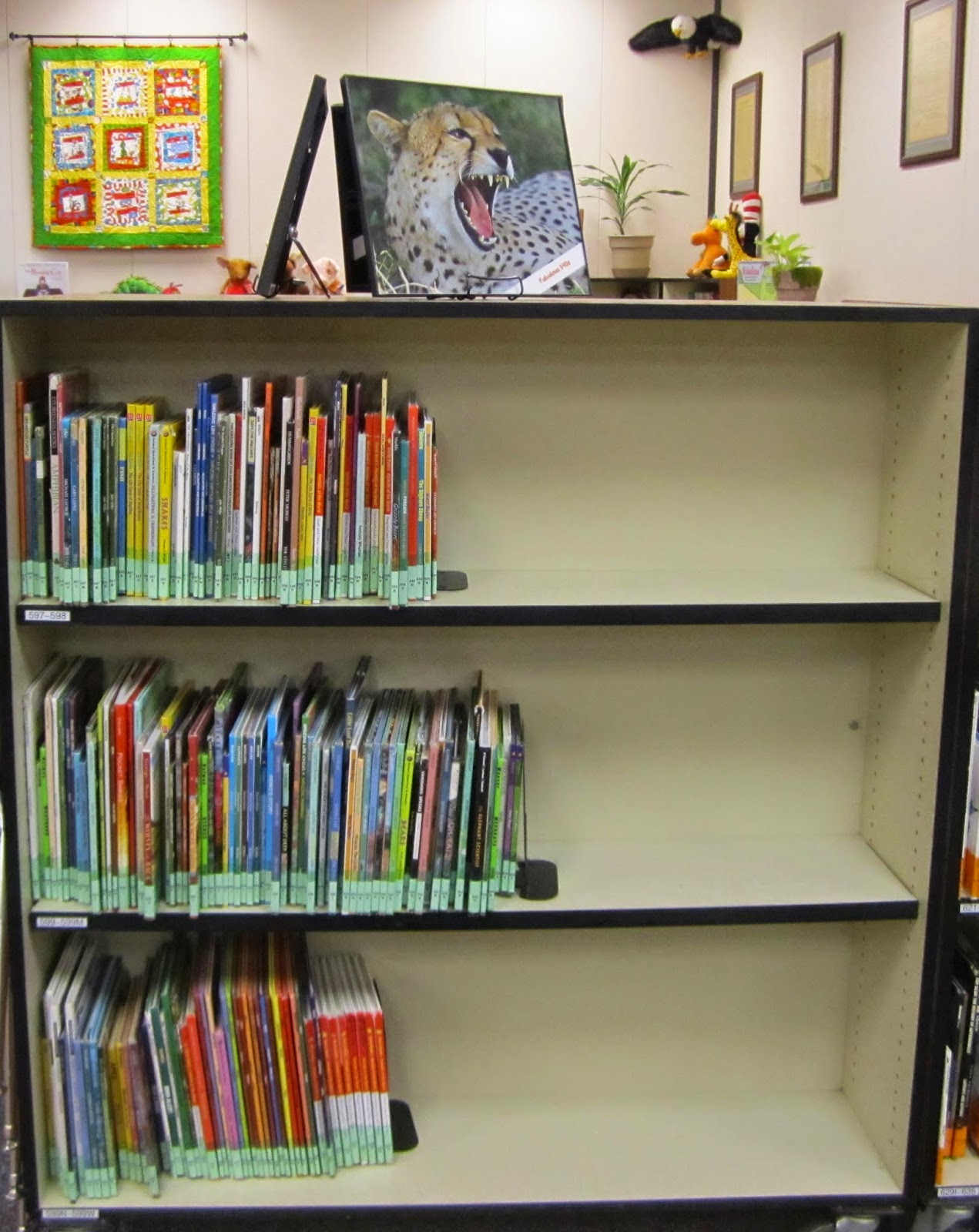
Two weeks into the event, our shelves are looking bare.
Our student recommendation wall.
You can find previous Fabulous 590s posts here, here, here, and here.

Wednesday, November 26, 2014

Fabulous 590s and Steve Jenkins

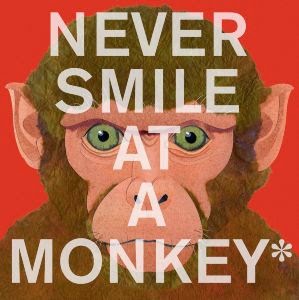
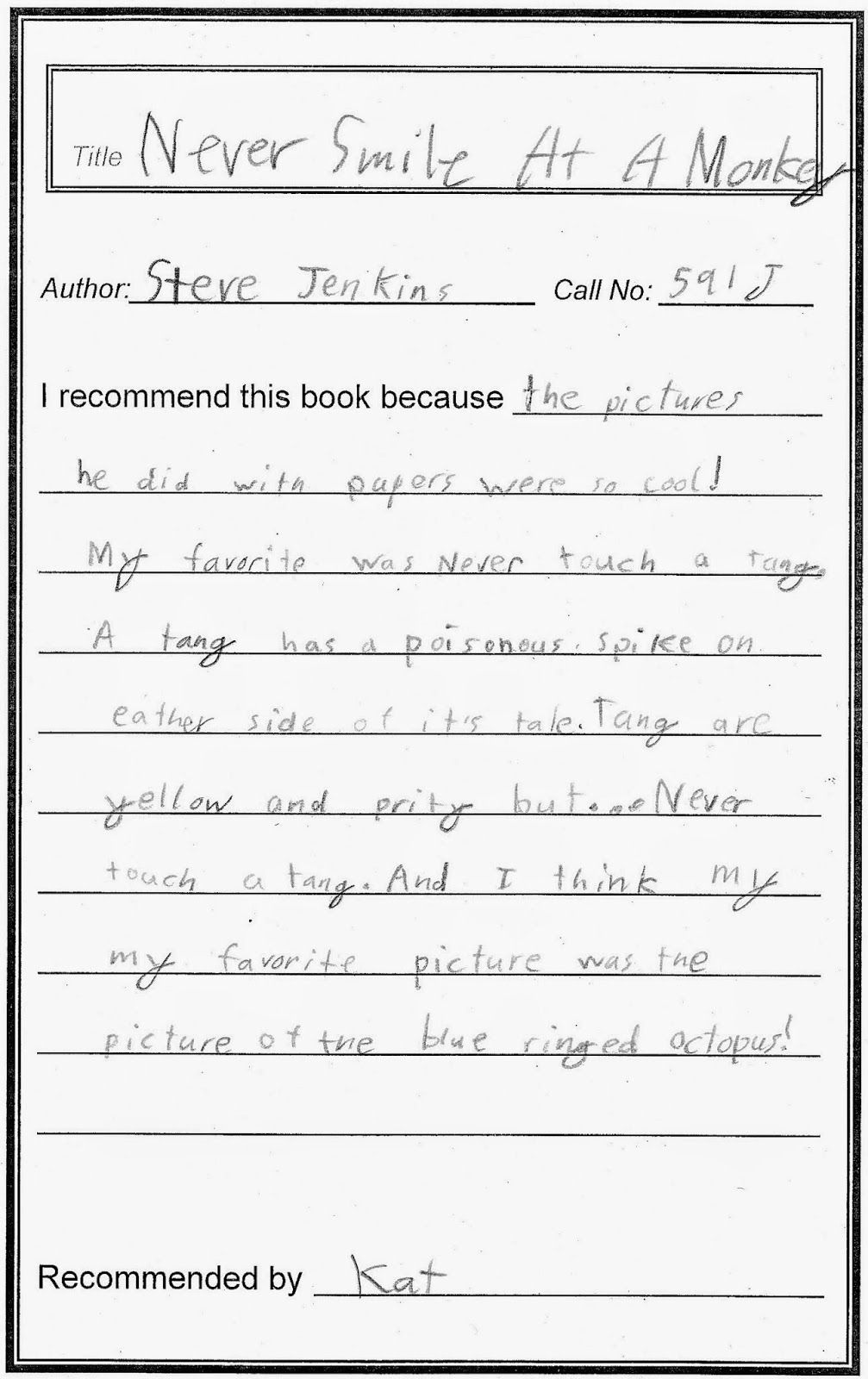
Did you know that the most deadly animal to humans is the mosquito?  Did you know that one of every four animals on earth is a beetle?  Did you know that when black widow spiders hatch, they begin to eat their brothers and sisters?  You can find these amazing facts and many others in Steve Jenkins's books.  We have a dozen titles by Steve Jenkins in our 590s, and we talked about them all.  No book was more popular than Never Smile at a Monkey which now has double-digit holds.  I shared it with a third-grade class, and before I made it through the first page, a boy had a question: "This isn't nonfiction--these are just supposed to be funny, right?"  After assuring him that it was all true, I continued, but still got a few incredulous looks.

Jenkins is a master of paper collage, and to my mind, one of his most striking pictures is the Siberian tiger in Actual Size (a title we pulled from our picture book section for this event).  We looked at the fur, the eyes, and the amazing detail as we talked about how Jenkins makes his pictures.  Nothing sums up the overall feeling as well as the comment made by a boy who was flipping through the pages of his book as he waited in line to check out:  "I can't believe he made these with paper!"

Here are a couple of student recommendations:


Monday, November 24, 2014

Fabulous 590s and Nic Bishop

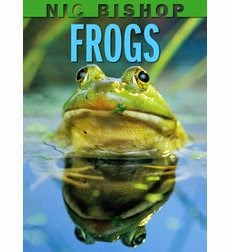
Laser detectors, flash guns, and hand-built shutters help Nic Bishop take phenomenal animal photos, but that's probably not what readers are thinking about when they pick up his books.  In fact, the photos are so captivating that you don't really think about a person being involved in their creation at all.  Instead, each feels like a unique story that you have happened upon just by turning a page.  Whether it's a baby koala waiting for his mother to wake up, a snake swallowing an egg, or a basilisk darting across a pond, Nic Bishop's photos express the action and emotion of you-are-there moments.

Nic Bishop has a great website with information about his photography, his research, his books, and his life.  These resources, combined with the notes at the back of his books, make booktalking his books a cinch.

I was sharing Nic Bishop Lizards with a fourth-grade class when one of the girls pointed to our display of books and asked, "Did he take the pictures for ALL these books?'

"Yes," I assured her, "He took them all."

"Really?  Even for the spider book?"

"Yep, even for the spider book."

I quickly changed my plan for that class and began telling them how Mr. Bishop had kept several of the spiders in his home and had even taken them "on holiday . . . if they needed special care".  Then I opened Nic Bishop Spiders to the title page.  That same girl took one look at the gorgeous crab spider camouflaged on goldenrod flowers, and her hand shot up again.  "Did he take THAT picture?"

"Yes, he took that picture."

Almost unbelievable . . . but true.

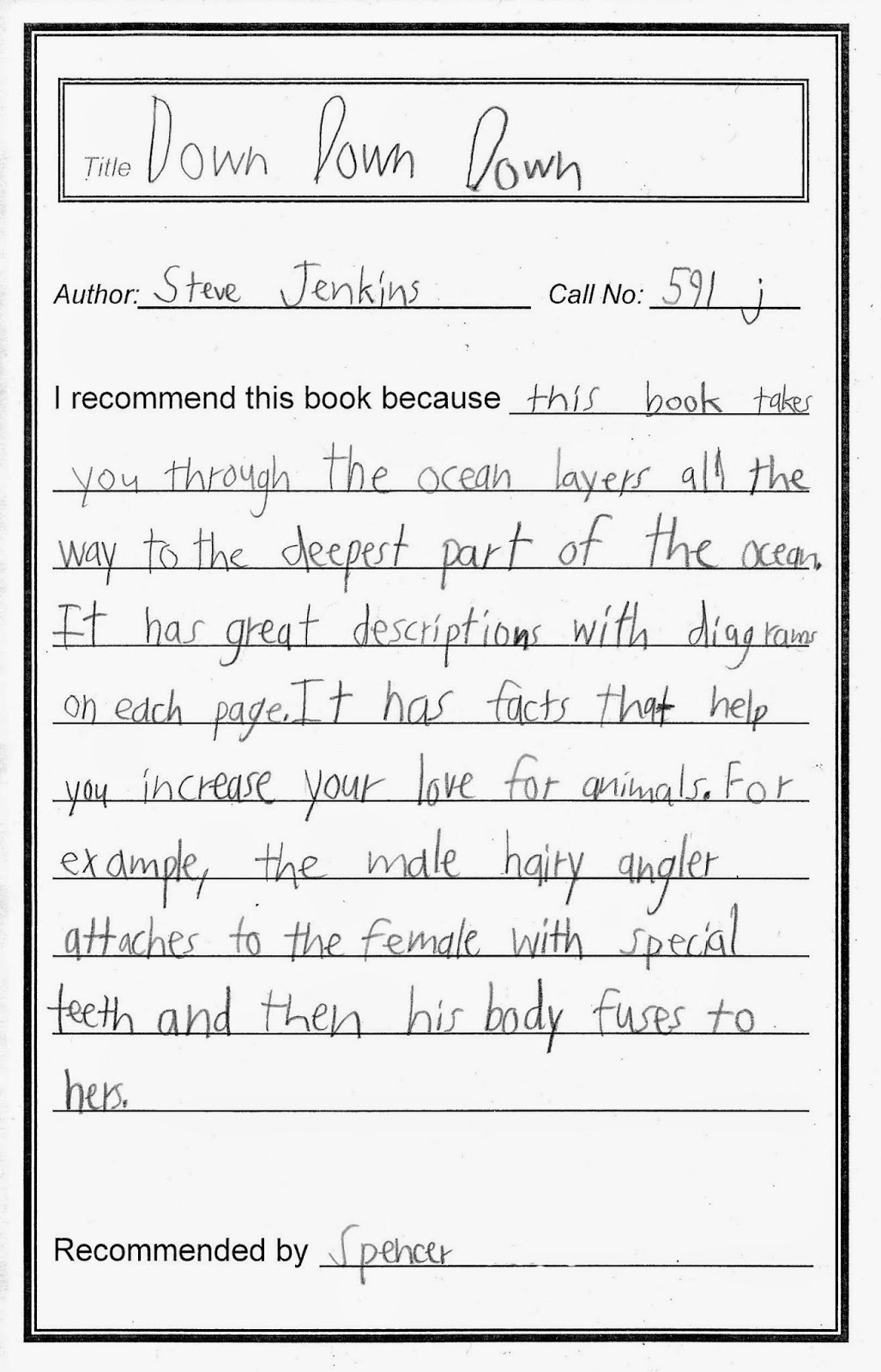
Here are a few student recommendations:


Tuesday, November 18, 2014

Fabulous 590s and Scientists in the Field

We kicked off our Fabulous 590s program with the fabulous Scientists in the Field series.  This series provides a diverse glimpse into the animal world--tapirs and tarantulas, kakapo and cheetahs, snakes and seahorses--by following scientists at work.  Engaging texts and stunning photography take readers right into the scientists' explorations as they ask questions, search for answers, overcome obstacles, and make discoveries.

Booktalks for twelve of the thirteen Scientists in the Field titles in the 590s section of our library were received with plenty of oohs and aahs, particularly when we showed photographs of the kakapo and the tree kangaroo.  After two days, all of our 590s Scientists in the Field books (including Kakapo Rescue which we moved from 639) were checked out.

My favorite moment was when two girls grabbed Project Seahorse at the same time and sank down to the floor, side-by-side, and began reading it.  They were so engrossed in the book that when one of them finally glanced up, she was startled to find the library empty and her class halfway down the hallway.  'Cause these books are just that good.

Here are a couple of student recommendations:


You can get more information on Scientists in the Field books here.  For updates on the research explored in the books, subscribe to Adventure Notes.  And oh, I can hardly wait for Octopus Scientist by Sy Mongomery--coming next year!

Monday, November 3, 2014

Lions and Tigers and Bears . . . and Lizards and Spiders and Turtles and Tapirs . . .

I don't really read nonfiction.  Nonfiction is just not my thing.  I haven't read that--it's nonfiction, right?  I can't count the number of times I have heard variations of this sentiment recently.  And as I was listening to Sy Montgomery (Kakapo Rescue, Chasing Cheetahs) speak at a conference this summer, I thought, Why?  Why are these captivating books so often dismissed?  Are we as enthusiastic book talking nonfiction titles as we are talking about the newest fantasy series?  What can we do to get our students excited about nonfiction?

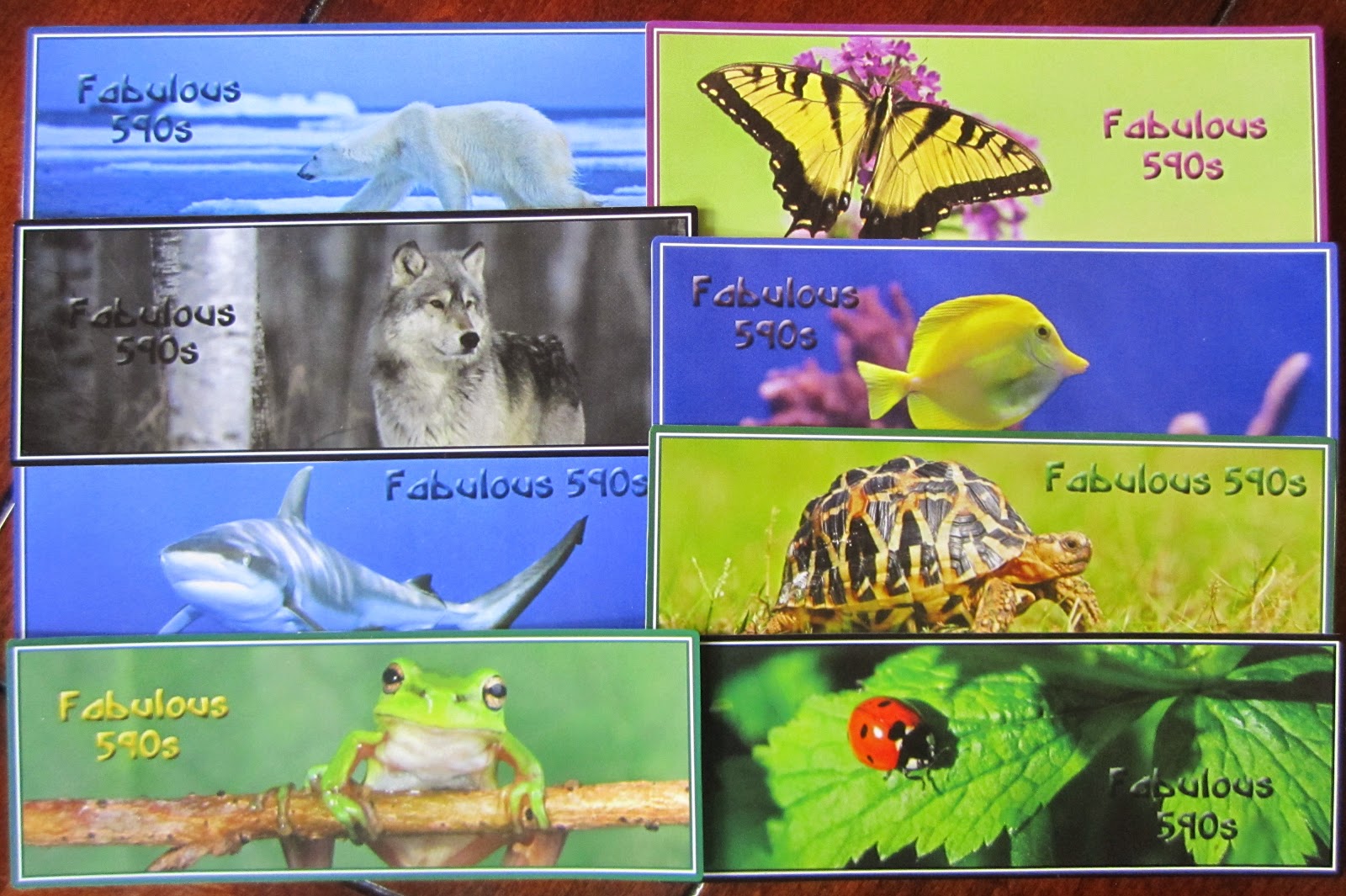
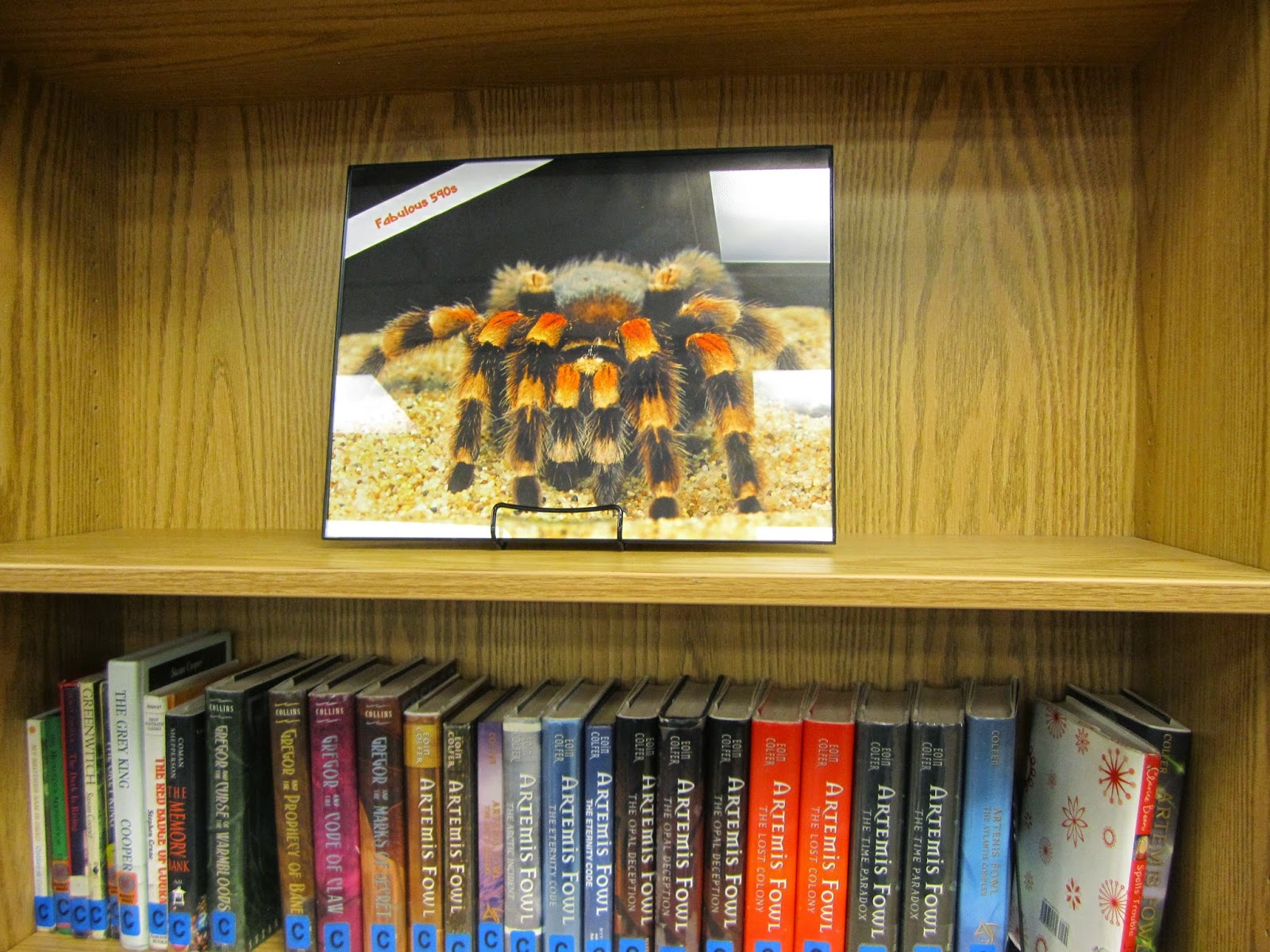
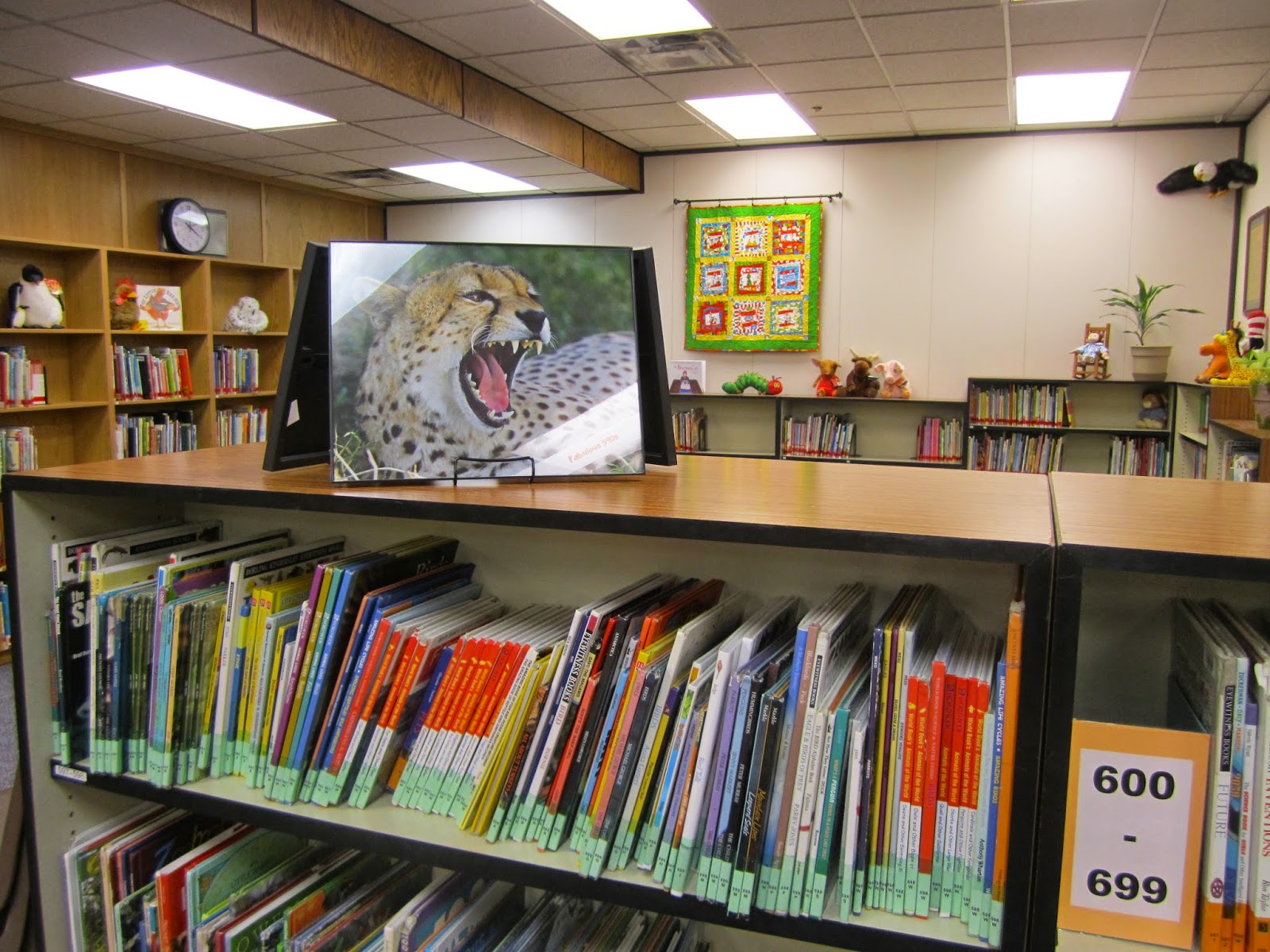
So, at our library, we have decided to celebrate nonfiction during November with an event called The Fabulous 590s.


Throughout the month we will be spotlighting many of the books from our 590-599 shelves.  And because nothing can rival the power of peer recommendations, we are encouraging our students to write about their favorite books.

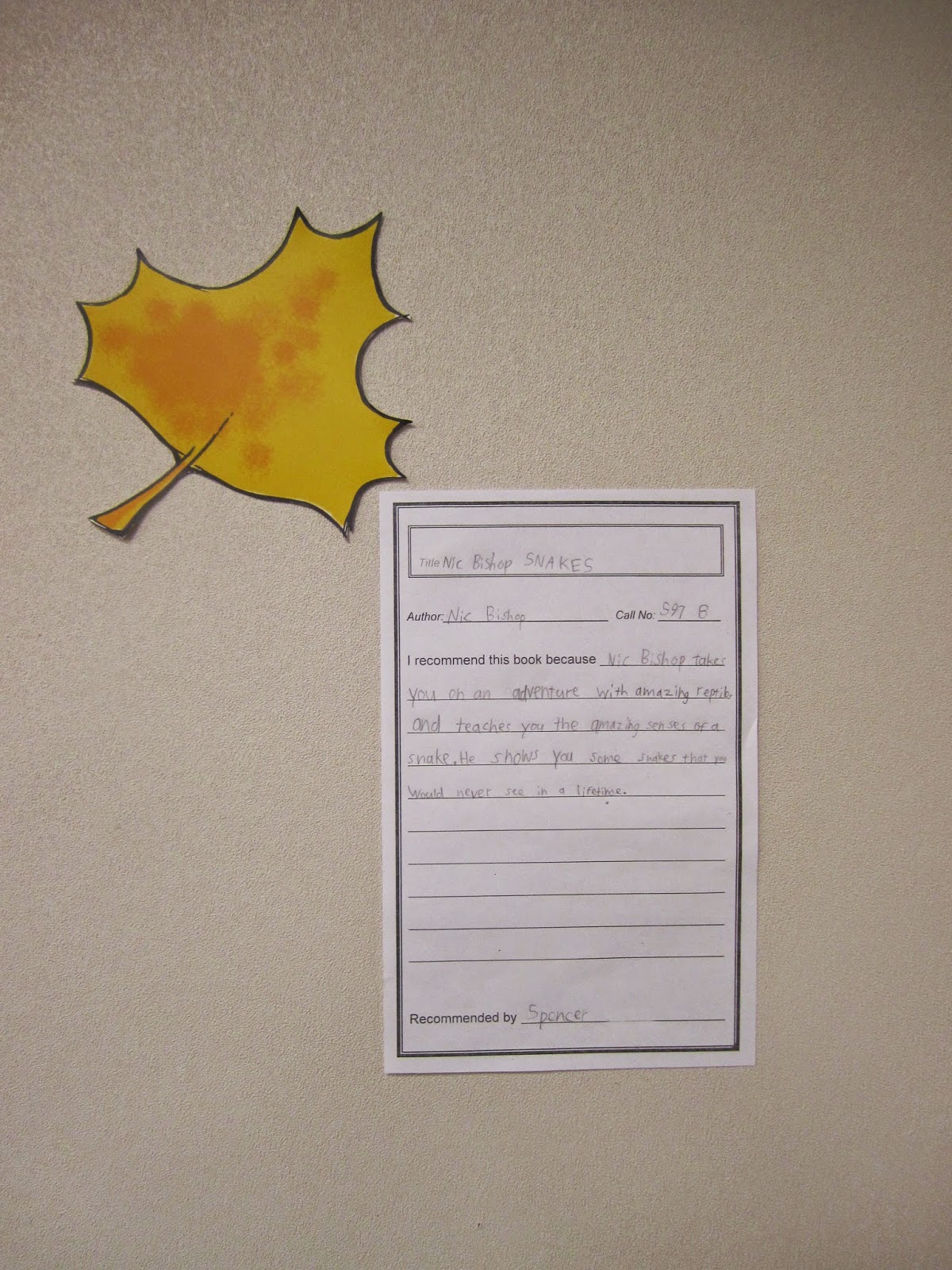
Student recommendation wall.
Our first recommendation.

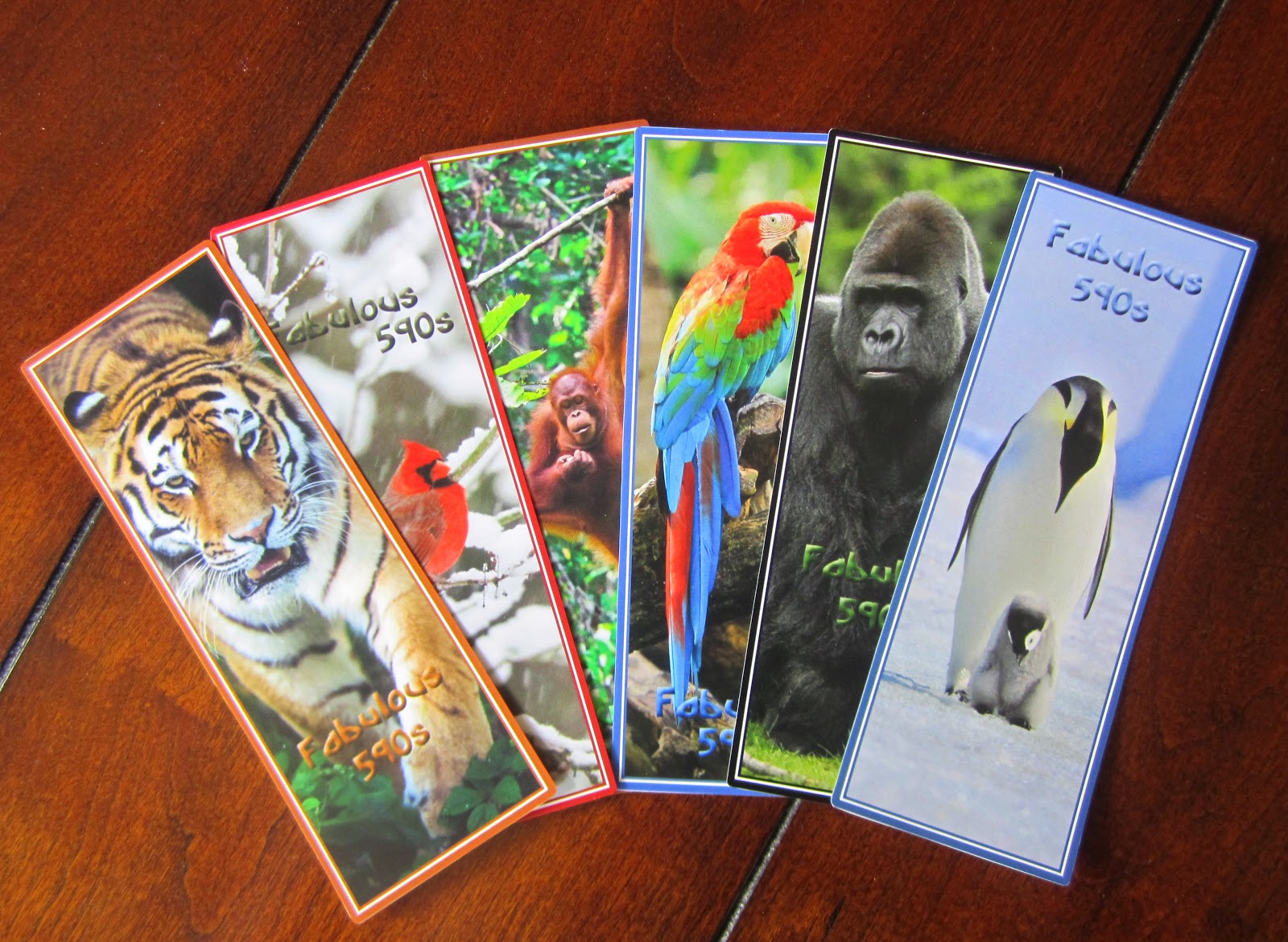
Bookmarks for students who recommend books.
More bookmarks.

Tarantula highlighting our event.

Our 590s shelves.

We are looking forward to a great month sharing fabulous books!

Thursday, September 25, 2014

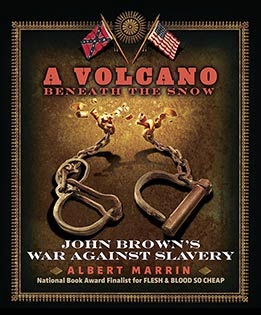
danyelle recommends A Volcano Beneath the Snow: John Brown's War Against Slavery by Albert Marrin

Some books capture a reader's attention with suspense-filled action, and you can hardly turn the pages quickly enough to find out what will happen next, while others present sympathetic characters that you come to care about.  Still others, render the setting so vividly that you can imagine being there yourself.  Certainly, these strengths are not mutually exclusive, and the books we love to read usually have multiple strengths.  And while Volcano Beneath the Snow does many things well, the thing that makes it stand out in my mind is the remarkable way it engages readers in ideas.

The narrative opens with a speech given by a tall, thin, sunken-cheeked man at a political meeting: "'A house divided against itself cannot stand,' . . . I believe this government cannot endure, permanently half slave and half free . . .'" (2)  These words spoken by Abraham Lincoln addressed a mid-nineteenth century crisis for our country, but the ideas they convey are still relevant today, as are the other questions introduced in the six-page prologue and explored throughout the text.

Can a man engage in villainous acts and be a hero? Should man act in strict obedience to the laws, thus supporting and upholding the government, or in obedience to his conscience?  Can violence in the pursuit of moral justice be righteous?   Marrin offers conflicting answers posited by Abraham Lincoln,  Henry David Thoreau, William Lloyd Garrison, Frederick Douglass, and of course, John Brown.

Brown grew up at the beginning of the nineteenth century when our country was young, restless, and divided by the issue of slavery.  Marrin addresses the rise of slavery, the terrible cost of the slave trade, and gives equal time to the problems facing the country and Brown's role in them.  (In fact, there are entire chapters when you can forget you are reading about Brown.)

Clashing viewpoints of abolitionists, Free-Soilers, and pro-slavery advocates underscore the complexity of the problem, thereby resisting simplification of this historical chapter into good guys versus bad guys.  And Marrin doesn't shy away from the harsh realities of racism and flawed individuals.  The honest portrayal of Lincoln's views in particular may surprise some readers.

In John Brown, readers meet neither a villain nor a hero, but a man whose life was filled with contradiction.  He had little formal education, was a troublemaker as a teen (bossy, aggressive, and prone to lying), and was fascinated by history.  He was deeply religious, highly opinionated, and "admired for his 'invincible honesty'".  (15)  And most importantly (to this story, at least) he firmly believed he was called by God to liberate slaves, and he embraced the use of terrorist tactics to do it.

Brown's execution does not come at the end of the book, just as his death did not end his influence.  The final sixty pages of the book lay out the chain of events that were triggered by Brown's failed plot at Harpers Ferry and end with the eventual abolition of slavery.

Marrin's conclusion looks at Brown's legacy, citing examples of men who acted on similar beliefs in recent times.  He says, "[Brown] raised thorny questions about the use of violence at a time when democracy seemed ineffective and the road to justice blocked by self-interest, brutality, and racism."--questions readers will ponder long after the last page.  (207)


A Volcano Beneath the Snow: John Brown's War Against Slavery
by Albert Marrin
published by Alfred A. Knopf
April 2014
recommended for ages 12 and up

Friday, July 18, 2014

Spotlight on Nonfiction 2014

The Scraps Book: Notes from a Colorful Life
by Lois Ehlert

The Scraps Book: Notes from a Colorful Life is like a mini-presentation Lois Ehlert printed and bound between two 8 ¼ inch-square covers.  With just a sentence or two per page (and an occasional third), Ehlert tells of her childhood, the inspiration for her art and stories, and her process for creating books.

Photographs of her parents, tools, supplies, and workspace, along with her artwork (both in progress and from her books) fill the pages, while notes label the pictures and provide additional detail.  She even shares a few art project ideas that readers can try.  The book’s scrapbook style is perfectly suited to the colorful collage art.

Fans of Lois Ehlert will love learning about her work, and budding artists may be inspired to create collages of their own.


He Has Shot the President!: April 14, 1865: The Day John Wilkes Booth Killed President Lincoln

by Don Brown

He Has Shot the President! is the most recent title in Don Brown’s Actual Times series--a series that

belongs in every library.  These excellent nonfiction books for younger children chronicle significant moments in America’s history such as the terrorist attacks of 9/11, the start of the Revolutionary War, and the discovery that triggered the California gold rush.

He Has Shot the President recounts the events of April 14, 1865--the day John Wilkes Booth shot President Lincoln, detailing not just the assassination, but also, the larger story of the conspiracy to cripple the Union’s leadership and the ensuing manhunt.

Brown’s use of sharp angles and diagonal lines creates emotion and movement in the watercolor illustrations.  With impeccable pacing and a tightly spun narrative, this book is enough to make a history fan out of anyone.


The Port Chicago 50: Disaster, Mutiny, and the Fight for Civil Rights 
by Steve Sheinkin


On July 17, 1944, just after 10 p.m., two explosions destroyed the 1200 ft pier at Port Chicago Naval
Magazine in California. 10 million pounds of ammunition packed into a naval ship created an immense bomb, destroying a second docked ship, disintegrating the locomotive and box cars on the pier, and killing 320 men. 202 of those men were black. (65-68)

Although the Navy began accepting black volunteers to train as sailors in 1942, they were strictly segregated, and at Port Chicago, the dangerous job of loading ammunition went only to black sailors. The men were not adequately trained to handle explosives, and white officers sacrificed safety for speed as they raced their divisions to load the most cargo. (47)

When the 328 surviving men from Port Chicago were ordered to return to loading ammunition at Mare Island Naval Shipyard a few weeks after the explosion, over 200 refused. After threats of court-martial, 50 men still refused to load ammunition under the same officers with unchanged conditions. These were charged with mutiny, resulting in the largest mass trial in U.S. Naval history.

Sheinkin is one the best writers of children’s historical nonfiction today. His narratives are engaging, powerful, and eminently readable. This story of 50 men primarily follows Joe Small (the man accused by prosecutors of leading the mutiny), keeping it focused and personal. Brief examples of segregation and racial discrimination endured by servicemen elsewhere give a broader context to the story. And contemporary reports and transcripts, recollections of participants, and photos bring this compelling moment in history to life.


The Family Romanov: Murder, Rebellion, and the Fall of Imperial Russia
by Candace Fleming

In 1903, 1.5 per cent of the Russian population owned 90 percent of the country’s wealth. (4)  While peasants and factory workers struggled just to get enough food to eat, this small minority enjoyed unparalleled privilege, fabulous wealth, and “an unshakable belief in their own superiority.” (4)  Foremost among these were the Romanovs: Tsar Nicholas who was ill-prepared to lead when he became Russia’s “Little Father” at age 26; Alexandra, his German-born wife, who was aloof and superstitious; the four Grand Duchesses who disappointed the Russian people by being born girls; and the heir, Alexei, who held a deeply-guarded family secret. (24, 31, 45, 55, 58)

Extensive research and first-hand accounts make this story of Russia’s last Imperial Family strikingly personal.  Fleming looks at people and events that were inextricably linked to the Romanovs (Lenin, Rasputin, peasants, factory workers, and World War I), but adroitly contains the details so they never threaten to eclipse her primary subject.  This bigger picture helps readers understand the social and political forces that led to unrest, revolution, and ultimately, the Romanovs’ demise.

This is Candace Fleming at her best.

*Review copy received from publisher.

Sunday, January 19, 2014

tara recommends The Boy on the Wooden Box by Leon Leyson

Nonfiction often gets a bad rap.  "True stories" are often deemed boring or unreadable and are put aside for fiction that is easier to digest.  In reality, the true stories are the most important ones as we come to appreciate where we came from and have a better understanding of the world around us.  Luckily, there have been some fantastic non-fiction books for younger readers in the past few years.  Bomb, Amelia LostStronger Than Steeland Nic Bishop Snakes are a few that have topped my list.  For even more nonfiction standouts, check out this list.

The Boy on the Wooden Box:  How the impossible became possible . . . on Schindler's list is the memoir of a young boy caught in the horrors of the Holocaust.  His story begins as a 9-year-old boy who lived a happy, relatively carefree life surrounded by family.  As the Germans invade Poland, this existence slowing changed as he started to see the "limitless inhumanity and evil of this new enemy."  Persecutions intrude on his life and his childhood slowly crumbles as he is forced into concentration camps and all basic comforts are stripped away.  He is ripped away from his family and struggles to survive through intuition, perseverance and pure luck as he holds on to the hope "if this is the worst that happens."  Unfortunately, that small hope is shattered as each time something much worse happens.

Leon Leyson (with Marilyn J. Harran and Elisabeth B. Leyson) tells a story of heartbreak, struggle and loss at the hands of the Nazis, but ultimately gratitude to the man who saved him.  Because of the kindness of Oskar Schindler, a Nazi who "looked [him] in the eye, not with the blank, unseeing stare of the Nazis, but with genuine interest and even a glint of humor," a man who would risk his own life to save nearly 1,200 Jews, Leon survived.

After the war, Leon started a new life and put his terrifying past behind him.  He married, started a family, began a teaching career, and rarely talked about his past.  He "did not live [his] life in the shadow of the Holocaust."  In fact, he until the movie, Schindler's List, came out, few people even knew about his past.  When he decided to talk about it, "Friends, students and teachers asked [him] why he had never told them about what [he] had experienced during the war."  They never realized what he had been through.  Once he was ready to come forward with his story, he shared his experiences for the rest of his life, speaking throughout the United States and Canada.

This memoir of a Jewish boy in Nazi Poland is not only compelling, without being graphic, but is also a stirring remembrance of a history that should never be repeated.  There are many books that tell a similar story of the needless horrors inflicted during this time, but I would highly suggest adding this one to your library as a memoir that even young readers can appreciate.

Copy received from publisher for review.

The Boy on the Wooden Box:  How the impossible became possible . . . on Schindler's list
A Memoir by Leon Leyson with Marilyn J Harran & Elisabeth B. Leyson
published by Atheneum Books for Young Readers
August 2013
Recommended for ages 9-15

Monday, June 24, 2013

danyelle recommends Stronger Than Steel by Bridget Heos

Because spider silk is stronger than steel and stretchier than nylon, it could, in theory, be used to make amazing artificial ligaments or tendons, parachute rope, fishing line, and bulletproof vests.  In theory.  This book, like others in The Scientist in the Field Series, examines the way theory becomes practical science.  Author Bridget Heos does that by taking readers inside Dr. Randy Lewis's spider silk lab.  Instead of presenting neatly wrapped-up answers, Stronger Than Steel looks at questions, ideas, and the search for answers.  By explaining concepts, problems, limitations, and the work in progress, Heos lets readers experience scientific process.

Why can't spider silk be harvested by domestically raised spiders?  Well, they would eat each other, and according to one of the scientists, Sherry Adrianos, "If you try to raise spiders together, you'll be left with one big spider" (12).  One solution might be transgenic goats that would produce spider silk in their milk.  Heos introduces readers to the scientists, the goats, and the ethical question surrounding genetically modified organisms.  Another solution might be raising silk worms that could spin spider silk, but although transgenic silkworms have spun silk that was a mixture of regular silk and spider silk, scientists don't know if the silkworms will be able to spin pure spider silk.

The balance between scientific explanation and human interest works nicely and may inspire readers to wonder, learn, and try some science of their own.

Beautiful photographs by Andy Comins show the scientists at work, the goats at play, and of course, the spiders.

Stronger Than Steel: Spider Silk DNA and the Quest for Better Bulletproof Vests, Sutures, and Parachute Rope
by Bridget Heos
photographs by Andy Comins
published by Houghton Mifflin Books for Children
February 2013
Recommended for ages 10 and up

Wednesday, April 10, 2013

Three Cheers: Memorable Nonfiction


I've been trying to think of at least one nonfiction picture book from my childhood, but I haven't been able to come up with one.  That doesn't mean they didn't exist, of course, but I can't name a single title.  Perhaps the books from my youth were just forgettable, but that is not the case now.  With books like Me . . . Jane by Patrick McDonnell, The Day-Glo Brothers by Chris Barton and Tony Persiani,  Nic Bishop's animal books, and others, we are seeing nonfiction picture books published that are engaging, visually captivating, and certainly, memorable.  Where once they may have been used primarily by teachers as classroom assignments, nonfiction picture books today are read and re-read by children who are fascinated by the stories they tell and the worlds they explore.  Here's a look at three recently-published, terrific picture books.

Perfect for preschoolers is Lucky Ducklings: A True Rescue Story by Eva Moore.  (While it may be classified as fiction, this book is based on an actual event, so I have taken the liberty of including it in a nonfiction post.)  When Mama Duck takes her five ducklings for a walk, the ducklings fall into a storm drain in their path.  People in the town come to the rescue and work together to get Mama Duck and her ducklings safely home.

Moore's rhythmic text repeats the ducklings' names, "Pippin, Bippin, Tippin, Dippin . . . and last of all, Little Joe," and Mama Duck's forceful, "Whack! Whack!" which makes the story a delight to read aloud.  Moore sets up suspense before the page turns and pulls listeners along with, "that could have been the end of the story.  But it wasn't because . . ."

Beautiful illustrations by Nancy Carpenter convey the ducks' personalities in a realistic fashion and are reminiscent of Robert McCloskey's Make Way for Ducklings.  I read this book to my kindergartner and then immediately, read it again.

Next up is a book for slightly older kids about an invention that most of them have probably never thought of as being invented--basketball.  Hoop Genius: How a Desperate Teacher and a Rowdy Gym Class Invented Basketball by John Coy is a spirited story that demonstrates creative problem solving at its best.

With an economy of words, Coy tells of James Naismith's attempts in 1871 to teach a rowdy gym class that no one else wanted.  Since it was winter, he tried playing games indoors--first, football, then soccer, and finally, lacrosse--but the resulting injuries led him to abandon each.  What he needed was a new game, and so, he invented one: basketball.  Played with a soccer ball and peach baskets, the first game was so successful that when "Naismith blew the whistle to end the game, nobody wanted to leave."  The story includes interesting detail, sometimes in the pictures like the attempted calisthenic and gymnastic training of the first two teachers who quit before Naismith took the class, and sometimes in the text which includes the name of the player who scored the only point in the first game.

Illustrations by Joe Morse--done in a palette of maroon, blue, gray, and brown--have a distinctly 19th-century feeling.  Angular, contorted figures convey the energy of the boys and the physicality of the games in full-page pictures.  As an added bonus, the original typewritten rules are reproduced on the end papers.

Last up is Brave Girl: Clara and the Shirtwaist Makers' Strike of 1909 by Michelle Markel, the story of one woman courageously standing up, speaking out, and influencing thousands.

When Clara Lemlich immigrates to America, she finds a job as a garment worker.  Conditions are unreasonable, and the details Markel provides emphasize that: half a day's wages lost for being late, locked doors, unsanitary conditions, and more.  Clara's meager pay helps buy food and contributes to the rent for her family, but Clara wants something better.  At night she studies in the library, and during the day she urges the girls who work with her to "fight for their rights" by striking.  She is beaten, jailed, and fired, but she perseveres.  Finally, at a union meeting, she calls for a general strike saying, "I have no further patience for talk" and starts "the largest walkout of women workers in U.S. history."  Again, details underscore the determination of the girls, some as young as twelve, to improve their conditions.

Melissa Sweet's illustrations incorporate stitching and fabric swatches, reflecting the garment workers' jobs.  She does a remarkable job representing the power of the companies and the insignificance of the girls with a dramatic overhead view showing rows of tiny girls at their machines and another picture of the large Triangle Waist Company building, which gives even more weight to Clara's efforts.  The opening picture of people looking toward the Statue of Liberty from the ship arriving in New York harbor is echoed in the final picture of Clara looking from the shore toward the same statue, bringing the story of a hopeful girl who finds out America can be unfair, full circle as she regains faith in her new country.

History brought to life with an engaging text and captivating illustrations--this is memorable.

Sunday, December 2, 2012

danyelle recommends Truce: The Day the Soldiers Stopped Fighting by Jim Murphy


For many people, day-after-Thanksgiving activities include shopping, enjoying leftover turkey, and hanging Christmas lights.  At our house, we pack away the autumn, Halloween, and Thanksgiving books and pull out the Christmas books.  Most of these are picture books, but a couple of them are nonfiction books that center around Christmas.  One of my favorites is Jim Murphy's Truce: The Day the Soldiers Stopped Fighting.

Murphy begins his account by briefly outlining the political complications and ambitions that started World War I and describing the propaganda from both sides.  He tells about weapons and battles, giving just enough detail to help the reader understand the horrors of the war, describing particularly the realities of war in the trenches.  Then with the soldiers in trenches, facing each other on either side of No Man's Land, he explains how on Christmas Day 1914, defying orders from their commanders, tens of thousands of soldiers, in a series of impromptu truces, stopped fighting.  Many met on No Man's Land; some exchanging gifts, others burying their dead and holding services, and still others, taking pictures.

First-hand accounts give insight into motivations of the soldiers and show a shift in their feelings toward each other.  At the onset of the war a young British lieutenant expressed his enthusiasm for joining the fighting, "Our major anxiety was by hook or crook not to miss it" (17).  And just a few months later a German officer reported, "When the order to fire was given, the men struck  . . . the officers . . . stormed up and down, and got as the only result, the answer, 'We can't -- they are good fellows, and we can't'" (86-87).  These moments fill the story with humanity, making it personal and real.

Murphy also incorporates sentiments of those who didn't want the Christmas truce, including a young Adolph  Hitler ("Such a thing should never happen in wartime.  Have you no German sense of honor left at all?") and German and British commanders who threatened those who were friendly with the enemy ("Commander Second Army directs that informal understandings with enemy are to cease.  Officers . . . allowing them are to be brought before a court-martial.").  But above all the story is of the men who had the courage to step out of the trenches and take a chance on peace.

What makes this feel like a Christmas book to me is not the fact that the informal truce occurred on Christmas, but the miracle of the truce itself -- the spirit of forgiveness and brotherhood that triumphed over hatred at least for one day -- as expressed by a British soldier, "This experience has been the most practical demonstration I have seen of 'peace on earth and goodwill towards men'" (81).

Plenty of photographs and illustrations depict the fighting and the friendliness.  I especially enjoyed the photograph of the German soldiers singing Christmas carols in the trenches on Christmas Eve.  A timeline, notes and sources, and index are appended.

Truce: The Day the Soldiers Stopped Fighting
by Jim Murphy
published by Scholastic
2009

Saturday, November 3, 2012

Picture Books -- Day 3


I didn't get around to reading Can We Save the Tiger? last year when it was published, so I picked it up today.  I thought it was going to be about . . . well, saving tigers, so I was surprised that tigers were not even mentioned until page 10.  While author Martin Jenkins does discuss tigers, the book is actually a broader look at animal conservation.  With an engaging text, Jenkins addresses extinct animals (dodos, Stellar's sea cows), endangered species (tigers, partula snails), and those that have recovered from the brink of extinction (American bison).  He concludes with the efforts being made to protect endangered species.

I had seen interiors shots of the book in reviews last year, but  I didn't appreciate the artistry of the illustrations by Vicky White until I saw them full-size in the book.  The predominately black-and-white pencil pictures capture the majesty of the animals, and where White uses oils to add color, the pictures glow.

This is a great book, so if you missed it last year, read it today.

Can We Save the Tiger?
by Martin Jenkins
illustrated by Vicky White
published by Candlewick Press
February 2011

Sunday, October 21, 2012

danyelle recommends Nic Bishop Snakes

At our house we divide responsibilities:  I help my children with any and all math homework, and my husband helps with the assignments that involve art.  Always.  So when my first-grader brought home a school project that involved clay, I happily got out of the way and let them work on it together.  I suppose it was a very serious project because they worked mostly in silence, but at one point my son broke the silence by saying, "I like to read nonfiction."

Quickly picking up this unexpected conversation, his dad replied, "Oh, I do, too.  I like to read books about history."

My son said, "I don't read much history.  I like to read books about animals."  And then after another interval of silence he added, "I get most of my information from books."

And that is probably why my sons and I were so excited when Nic Bishop Snakes came out this year.  Nic Bishop combines fascinating information about animals and stunning photography to make books that we love to read again and again.

Not attempting an exhaustive overview, Bishop instead gives readers a glimpse into the world of snakes, discussing physical attributes (the green anaconda "may weigh more than 400 pounds"), feeding habits ("eight big meals a year are enough for many snakes"), and defenses ("a viper can strike  . . .as fast as you can blink").  He highlights specific snakes, including the handsome fellow on the cover -- the parrot snake.

But the thing that makes this book stand out is the spectacular, full-page photography.  Whether close-up or actual size, each photograph shows not only a different snake, but subtly directs the reader's attention to a particular snake characteristic.  The green tree python shows off gorgeous green coils.  The venomous feathered bush viper's scales are prominent in a photo that is 3 times actual size. The Asian sand viper and the Gaboon viper demonstrate camouflage dramatically.  The emerald tree boa sticks out his tongue, and the eyelash viper displays some really scary fangs.  Bishop gives readers a you-are-there experience with pictures that feel impossibly real.  (Actually, since I wouldn't linger to examine any snake I came across in the wild, I got a better-than-you-are-there experience.)  And each photo is one you'll want to linger over, except perhaps the one of the garter snakes -- that'll give you nightmares.

Now, a quick word about the book's design. The colored text pages complement the photographs, particularly the brilliant yellow that picks up the pattern on the Mandarin rat snake.  The smaller type used to spotlight the specific snakes helps pacing.  But the larger, bold type used to highlight a sentence on each page of text is disturbingly random.  While some of the sentences seem like main ideas for the page, others do not.  Why would, "That is why many snakes ambush their victims" be emphasized?  Also, certain paragraphs felt out of place and would have made more sense on a previous page.

But these are small quibbles that shouldn't keep you from picking up the book.  Who else but Nic Bishop could make a feathered bush viper look adorable?  In the end notes, Bishop said he wanted to "show how beautiful snakes are" and he did it!

Nic Bishop Snakes
by Nic Bishop
published by Scholastic
October 2012

Recommended for ages 5 and up

Wednesday, September 12, 2012

Try It, You'll Like It

Everywhere I go lately, I run into--or at least trip over--conversations about Common Core State Standards.  While opinions on the initiative's implementation vary, one thing seems inevitable: with a recommendation that 50% of the texts for grade school students and 70% for high school students be informational, teachers will be seeking out more nonfiction books for their classrooms.

"What Common Core Means for Publishers," an article from the July 16, 2012 edition of Publishers Weekly, quotes author Sy Montgomery:
"I think nonfiction has been overlooked for so long.  Kids themselves have believed that nonfiction books are just big books of boring answers."  (p. 16)
When I was a kid, I certainly felt this way.  My textbooks were boring, and I read other nonfiction primarily to find boring answers for reports (probably also boring) that I had to write.  For years I derived little pleasure from my nonfiction reading.  About five years ago, that changed when I started reading some of the newly published nonfiction titles, and found that I actually enjoyed them.  These books were not the boring books I remembered from my childhood, but books with fresh perspectives, interesting details, engaging narratives, and well-chosen photographs and illustrations.  More than just facts strung together to create sentences, paragraphs, and chapters, these books told stories, explained phenomena, and opened worlds.  In fact, for the past few years, several of my favorite children's books have been informational ones.
  • Marching for Freedom: Walk Together Children and Don't You Grow Weary by Elizabeth Partridge (2009).  This narrative about the role children played in the fight for the right to vote is excellent, and boy, does Elizabeth Partridge know how to choose photographs that pack a punch.
  • Nic Bishop: Lizards by Nic Bishop (2010).  We love anything by Nic Bishop at our house.  (Okay I have a hard time reading Spiders, but that is just because I am squeamish.)  For the photographs alone, I would love this book. The great descriptive text is an added bonus.
  • The Notorious Benedict Arnold: A True Story of Adventure, Heroism & Treachery by Steve Sheinkin (2010).  This is history nothing like the one paragraph I remember reading in my textbook about Benedict Arnold--riveting.
  • The Day-Glo Brothers by Chris Barton, illustrated by Tony Persiani (2010).  A picture book about the brothers who invented fluorescent paint, this book actually uses Day-Glo colors for the eye-popping illustrations 
  • Me . . . Jane by Patrick McDonnell (2011).  This picture book looks at Jane Goodall's passion for her research by focusing on her dreams as a child.
  • Balloons Over Broadway: The True Story of the Puppeteer of Macy's Parade by Melissa Sweet (2011).  Impressive for the fact that it inspired me to watch the parade on Thanksgiving (well, some of it anyway), this tells the inspirational story of how the puppets in the Macy's Parade came to be.  Beautiful illustrations enhance the clear, straight-forward text.  
  • Amelia Lost: The Life and Disappearance of Amelia Earhart by Candace Fleming (2011).  2011 was the year I fell in love with books that I didn't want to like.  I don't like parades, didn't think I would like a picture book about Jane Goodall, and certainly was not interested in reading about Amelia Earhart.  But this book about Amelia Earhart won me over.  Candace Fleming alternates the story of Earhart's life with the search for her after her disappearance, creating tension in a story that was hard to put down.
2012 is turning out to be another great year for nonfiction.  Look at just some of the recently published titles.
  • Green by Laura Vaccaro Seeger (Mar)
  • Nic Bishop: Snakes by Nic Bishop (Oct)
  • A Black Hole Is Not a Hole by Carolyn Cinami DeCristofano, illustrated by Michael Carroll (Feb)
  • Master of Deceit: J. Edgar Hoover and America in the Age of Lies by Marc Aronson (Apr)
  • Invincible Microbe: Tuberculosis and the Never-Ending Search for a Cure by Jim Murphy (Jul)
  • Moonbird: A Year on the Wind with the Great Survivor B95 by Phillip Hoose (Jul)
  • Bomb: The Race to Build-and Steal-the World's Most Dangerous Weapon by Steve Sheinkin (Sep)
  • The Impossible Rescue: The True Story of an Amazing Adventure by Martin W. Sandler (Sep)
There is not enough time in my day to read all the promising books this year.

Some of my children prefer factual books to fiction.  Without any encouragement from me, they choose to read stories that actually happened, look at photographs of fascinating--yet real--animals, and read about scientific discoveries.  But persuading those who are a little reluctant to pick up a nonfiction book should be easy (or at least easier) with all the great books being published now.

And I guess I'm going to have to finally admit that I'm a big nonfiction fan.